


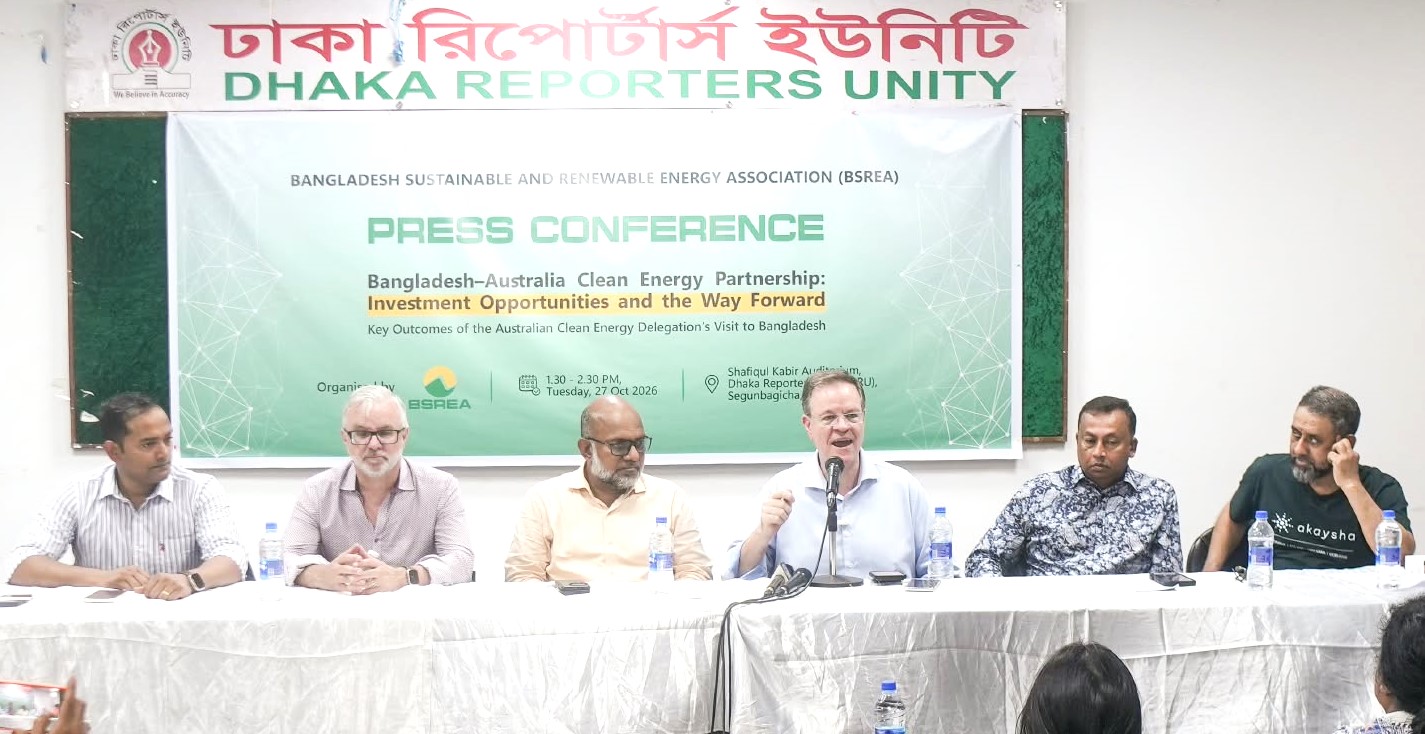
Australian clean energy companies are exploring investment and joint venture opportunities in Bangladesh, with a focus on rooftop solar, battery energy storage and local manufacturing.
A four-day Australian business delegation visited Bangladesh from 24 to 27 October to discuss investment, technology transfer and commercial partnerships with government officials, investors and energy sector representatives, the Bangladesh Sustainable and Renewable Energy Association (BSREA) said on Tuesday.
At a press conference at the Dhaka Reporters Unity, BSREA said industrial and commercial rooftop solar, battery storage systems, solar-powered irrigation and decentralised electricity generation offered significant investment potential.
The visit was organised with local coordination from BSREA, in collaboration with the Renewable Energy Council Asia-Pacific (RECAP), the Smart Energy Council and Austrade.
The delegation met Bangladesh Investment Development Authority (Bida) chairman Chowdhury Ashik Mahmud Bin Harun on 24 October to discuss foreign investment opportunities, the business environment and policy support for renewable energy projects.
On 25 October, the visitors attended a briefing on Bangladesh’s clean energy market, covering sector policies, project opportunities, financing, rooftop solar and battery storage. A seminar and business networking session organised by BSREA brought together representatives from government agencies and private companies.
The delegation also took part in a seminar organised by the Australia Bangladesh Chamber of Commerce and Industry on renewable energy, emissions reduction and the energy transition. Separate meetings with the commerce minister and the power division secretary focused on expanding bilateral trade, investment and technical cooperation.
On the final day, the Australian representatives attended the opening of Renewable Energy Fest 2026 at the Bangladesh University of Engineering and Technology (BUET), followed by a dialogue organised by BSREA on investment, research, innovation, technology transfer and workforce development.
Local manufacturing in focus
Bangladesh could attract Australian investment not only in renewable power generation but also in the manufacture and assembly of solar panels, inverters and batteries, according to BSREA.
Joint ventures could help transfer technology, strengthen domestic manufacturing capacity, create jobs and develop a skilled workforce.
Australia’s experience in battery storage, integrating renewable energy into the national grid and electricity market operations could also support Bangladesh as it expands clean power generation.
Other potential opportunities include floating solar, onshore and offshore wind power, waste-to-energy projects and carbon credits.
However, BSREA said investors would need a stable, transparent and predictable policy environment to turn these opportunities into viable projects.
The association called for a coherent legal and regulatory framework covering different renewable energy technologies and business models. It also highlighted the need for transparent procurement, reliable power purchase agreements, effective grid connections and better co-ordination among government agencies responsible for project approvals.
High financing costs remain a barrier
Access to affordable, long-term finance remains a major challenge for renewable energy development in Bangladesh, BSREA said.
High interest rates, substantial upfront capital requirements, complex banking procedures and short loan repayment periods can make projects difficult to finance.
The association urged international development finance institutions, multilateral development banks, climate funds and domestic banks to work together to provide longer-term funding at more affordable rates.
Suitable financing will be particularly important for projects such as battery storage and distributed solar, which can require significant initial investment before generating returns.
Turning talks into investment
BSREA said the delegation’s visit had created new opportunities for collaboration between Australian and Bangladeshi companies, policymakers, investors and researchers.
The next step will be to identify viable projects and translate discussions into concrete partnerships in investment, technology transfer, local production and skills development.