


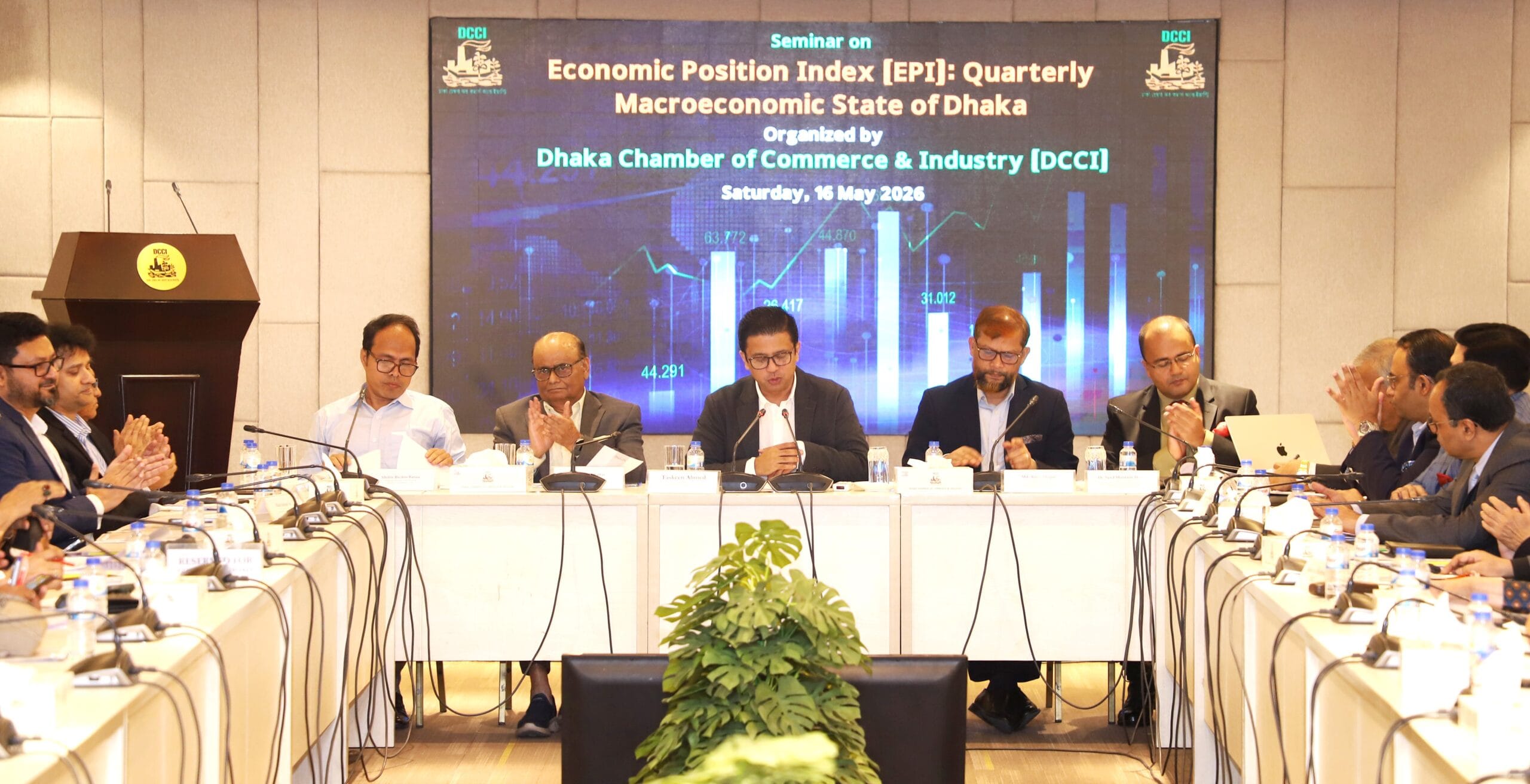
Leading economists, policymakers and business leaders on Saturday sounded the alarm over persistent inflation, a prolonged investment slowdown and an acute energy crunch, cautioning that the combined pressures are weighing heavily on Bangladesh’s macroeconomic stability.
The concerns emerged at a seminar on the newly introduced Economic Position Index (EPI), organised by the Dhaka Chamber of Commerce and Industry (DCCI) in the capital, where speakers called for urgent, coordinated policy action to stabilise the economy and revive investor confidence.
DCCI President Taskin Ahmed said the economy is navigating a “challenging phase”, marked by elevated inflation, pressure on foreign exchange reserves, sluggish private investment and uncertainty in energy supply.
He noted that declining employment opportunities are further intensifying economic stress.
Arguing that conventional macroeconomic indicators often fail to reflect short-term dynamics, he said the EPI has been introduced to provide a more real-time assessment of economic conditions and support informed decision-making by both policymakers and businesses.
Presenting the keynote paper, DCCI Acting Secretary General Dr AKM Asaduzzaman Patwary said the index is based on data from the first half of FY2025–26, drawing on feedback from 762 respondents across the manufacturing and services sectors.
The study paints a broad picture of stress across key sectors: climate change impacts are dampening agricultural output, energy shortages are disrupting industrial production, and weakened purchasing power is constraining the services sector.
To address these challenges, the paper recommends stabilising agricultural markets, strengthening supply chains, expanding access to low-cost finance for SMEs, ensuring uninterrupted energy supply, accelerating infrastructure development and streamlining licensing procedures to reduce bureaucratic hurdles.
International trade expert Nesar Ahmed warned that small and medium enterprises could be disproportionately affected following Bangladesh’s graduation from the LDC category, particularly due to the likely loss of duty-free access to European markets. He stressed the need to lower the cost of doing business and enhance policy support.
Additional Secretary at the Ministry of Commerce Shibir Bichitra Barua identified high inflation, negative investment trends and vulnerabilities in the banking sector as the economy’s key challenges, adding that efforts are underway to modernise import policies and improve the ease of doing business.
Professor Dr Mizanur Rahman of the University of Dhaka said sustained higher spending relative to income in both public and private sectors has added to macroeconomic pressure in recent years, while investment stagnation has slowed overall economic momentum.
Director General at the Ministry of Foreign Affairs Dr Syed Muntasir Mamun highlighted Bangladesh’s continued overreliance on the banking sector for long-term industrial financing, underscoring the need to develop a more effective capital market.
Joint Secretary of the Bangladesh Investment Development Authority (BIDA) Md Ariful Haque said greater digitalisation of public services could significantly reduce procedural delays and business hassles.
Prof Akhand Mohammad Akhtar Hossain, chief Economist at Bangladesh Bank, emphasised that boosting foreign direct investment remains critical for sustaining higher growth, noting that Bangladesh still trails behind peer economies in attracting FDI.
Senior Private Sector Specialist at the International Finance Corporation (IFC) Mia Rahmat Ali called for stronger policy and financial backing for entrepreneurs to help them weather global economic uncertainties.
DCCI Senior Vice-President Rajib H Chowdhury, Vice-President Md Salim Sulaiman and other board members were also present.