


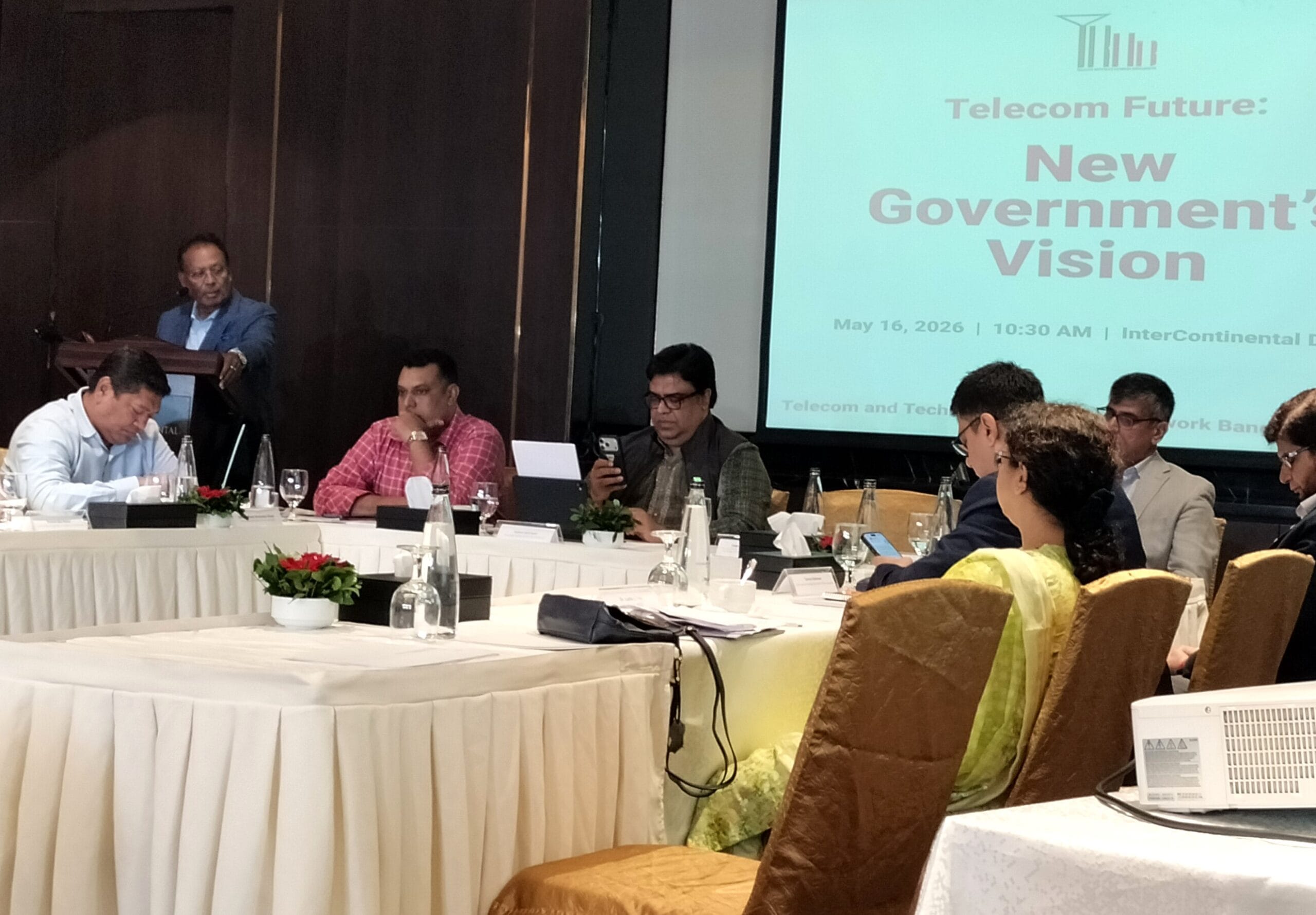
Bangladesh’s telecom industry has called for a predictable five-year tax framework and sweeping regulatory reforms to unlock investment and support the country’s digital transformation ambitions, according to speakers at a high-level roundtable in Dhaka on Saturday.
The event, titled “Future of the Telecom Sector: What Is the New Government Thinking?”, was organised by the Telecom and Technology Reporters Network Bangladesh (TRNB) at the InterContinental Dhaka.
Industry leaders, regulators and policymakers warned that Bangladesh risks falling behind regional peers unless it modernises its telecom policies, streamlines licensing and reduces the cost burden on operators and technology providers.
Addressing the gathering, Posts, Telecommunications, ICT and Science Minister Fakir Mahbub Anam said the government was prioritising the expansion of 5G and artificial intelligence technologies into rural areas while strengthening cybersecurity infrastructure.
He said the administration aimed to create 10 million jobs over the next five years and stressed that state-owned telecom assets would not be privatised.
“We are committed to controlling corruption in this sector and ensuring nationwide fibre-optic connectivity,” the minister said.
Prime Minister’s Adviser Rehan Asif Asad said the government was drafting a long-term telecom policy roadmap aimed at helping Bangladesh become a trillion-dollar economy by 2035 and enter the world’s top 20 telecom markets.
He added that the telecom sector’s contribution to GDP was targeted to rise from 8% to 15%.
Responding to demands from operators and investors, Asad confirmed that the government was considering a “long-term and predictable” tax reform package in the upcoming national budget, potentially covering a five-year period.
BTRC Chairman Major General (Retd.) Emdad Ul Bari said the regulator was preparing a “National Connectivity Master Plan” and pledged that the country’s future licensing system would avoid monopolistic market structures.
He also urged operators to provide evidence supporting claims that lower spectrum prices would increase overall government revenue.
In a keynote presentation titled “Shaping the Era of Telecom: Bangladesh Perspective”, Robi’s Head of Regulatory and Corporate Affairs, Barrister Sahed Alam, argued that although Bangladesh had achieved widespread connectivity, it had yet to emerge as a regional innovation hub.
He identified five key priorities for the sector including a predictable long-term revenue and taxation framework, modern spectrum policy reforms and strong cybersecurity and data security etc.
Alam also called for global digital platforms to contribute fairly to the cost of rising data traffic.
“If Bangladesh wants a genuine digital economy capable of generating high-value employment and stronger GDP growth, telecom policy must become modern and investment-friendly,” he said.
Competition law expert and former Bangladesh Competition Commission director Khaled Abu Naser warned that around 91% of market profits were concentrated within a single company, raising concerns over monopolistic practices.
He called on the Bangladesh Telecommunication Regulatory Commission (BTRC) to work more closely with competition authorities instead of focusing primarily on revenue collection.
Meanwhile, Mobile Telecom Operators of Bangladesh (AMTOB) Secretary General Lt Col (Retd.) Mohammad Zulfikar urged the government to ensure uninterrupted electricity and fuel supplies for data centres and digital infrastructure projects to support foreign direct investment.
FICCI Chief Executive TIM Nurul Kabir called for a clear telecom roadmap, stronger inter-ministerial coordination and tax reforms, including VAT registration changes within the telecom regulator.
Telecom experts also pressed for the digital transformation of BTRC operations, simpler licensing procedures and improved service quality standards.
Representatives from Banglalink and state-owned operator Teletalk highlighted ongoing challenges surrounding spectrum pricing, fibre network expansion, infrastructure sharing and state investment support.
The roundtable concluded with broad consensus among participants that Bangladesh requires a stable, investment-friendly and non-discriminatory policy environment to accelerate economic growth and strengthen the country’s digital future.