


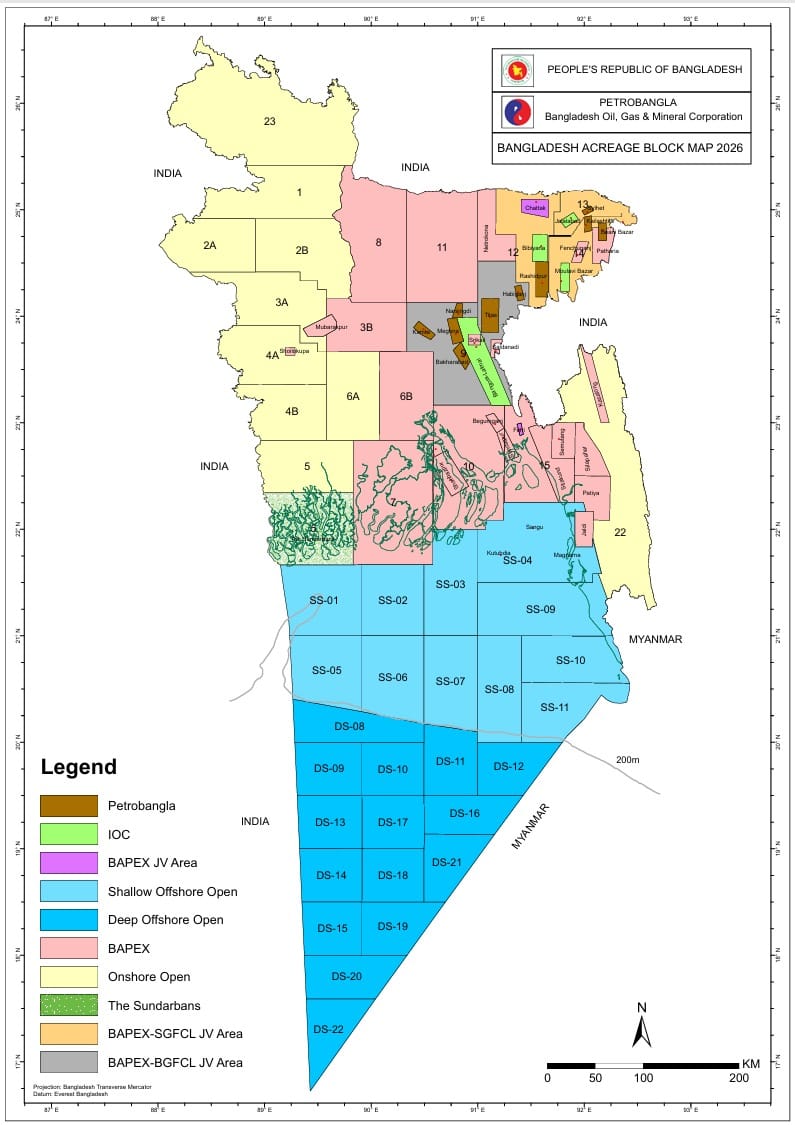
Bangladesh will launcha offshore bidding round 2026 tomorrow aimed at attracting international oil companies (IOCs) to explore vast untapped oil and gas reserves in the Bay of Bengal, as the South Asian nation seeks to tackle mounting energy shortages and reduce reliance on imported fuels.
The government, state-owned energy corporation Petrobangla, will formally invite International Oil Companies (IOCs) to bid for 26 offshore oil and gas exploration blocks under the newly updated Bangladesh Offshore Model Production Sharing Contract (MPSC) 2026 in the Bangladesh Secretariat.
The offering includes 11 shallow sea blocks and 15 deep sea blocks, covering large areas of Bangladesh’s maritime territory in the Bay of Bengal — a region believed to hold significant hydrocarbon potential but which remains largely underexplored compared with neighbouring India and Myanmar.
The move marks one of Bangladesh’s most ambitious offshore energy drives in recent years, coming amid rising domestic demand for electricity and industrial fuel, declining gas output from mature onshore fields, and increasing pressure on foreign exchange reserves caused by expensive liquefied natural gas (LNG) imports.
Officials hope the revised fiscal terms and investor protections in the MPSC 2026 framework will help attract major global energy players after previous bidding rounds struggled to generate strong international participation.
Investor-Friendly Terms
Under the new framework, Bangladesh is offering several incentives designed to improve commercial attractiveness for foreign operators.
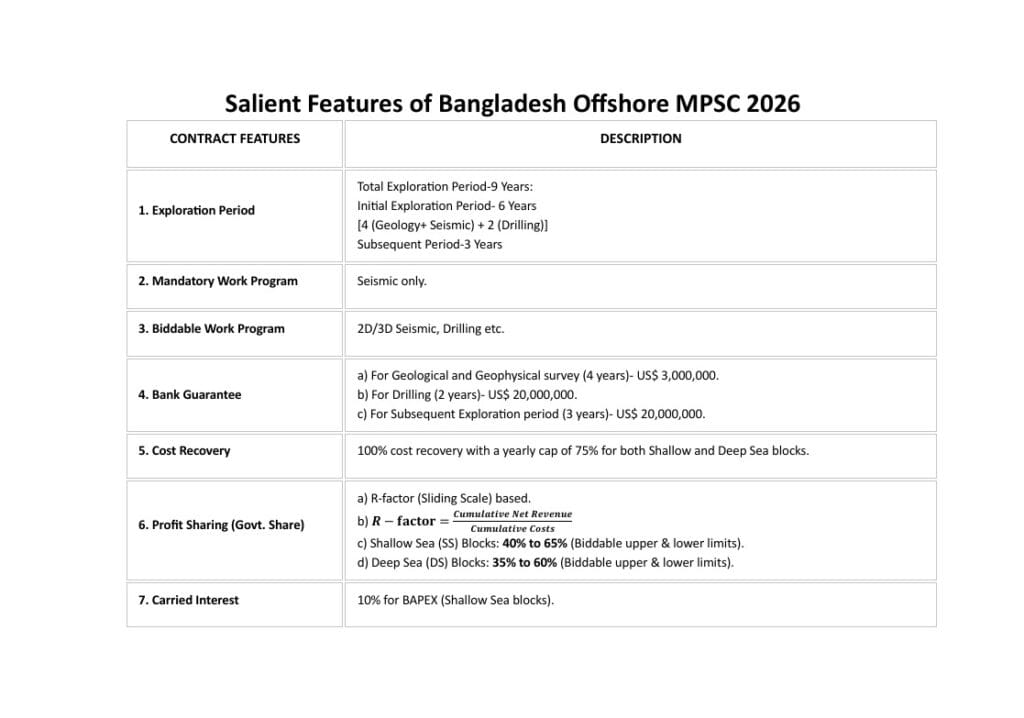
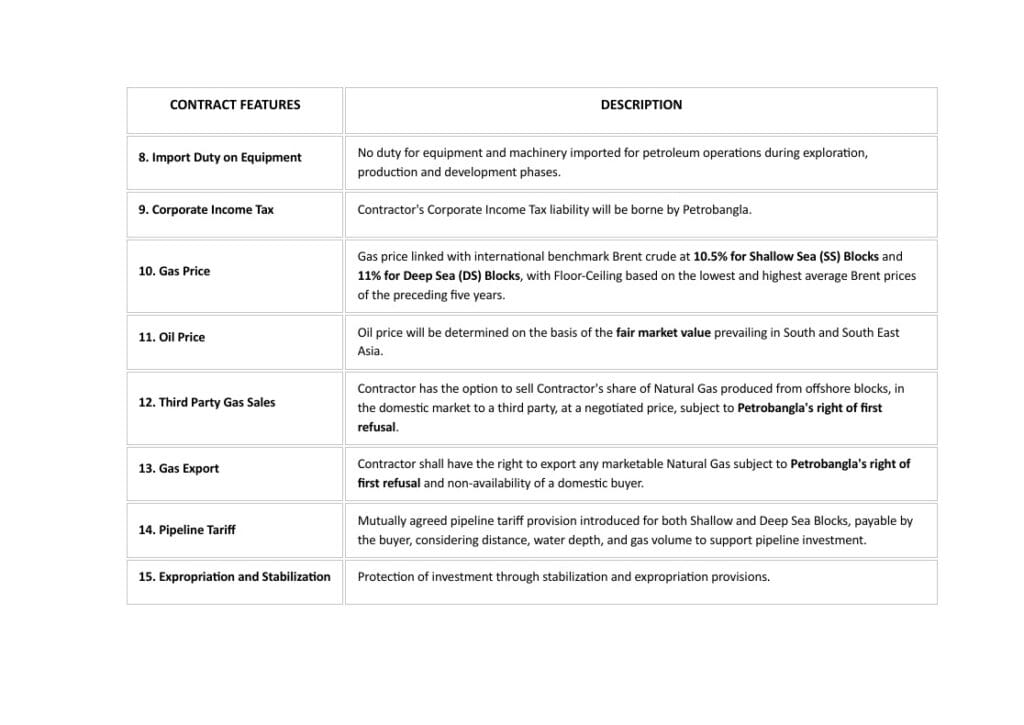
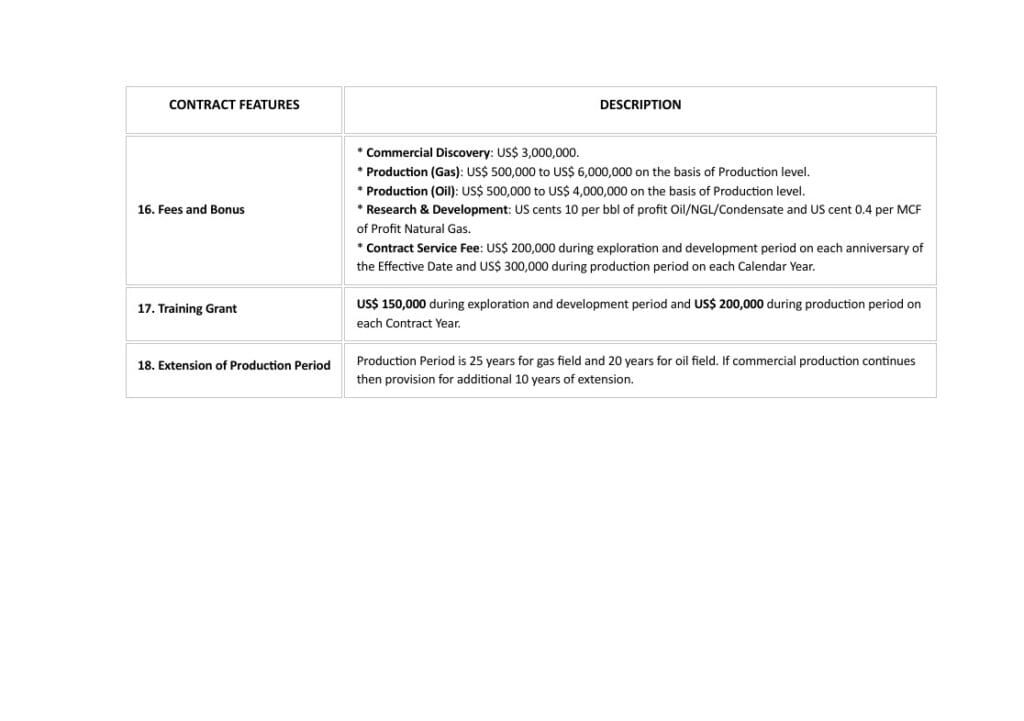
Key contract features including full repatriation of profits; no signature bonus or royalty payments; gas pricing linked to Brent crude benchmarks; 100% cost recovery with an annual cap of 75%; tax liabilities borne by Petrobangla; duty exemptions on imported exploration and production equipment; rights to export contractors’ shares of natural gas, subject to Petrobangla’s first refusal option and stabilisation and expropriation protection clauses for investors.
The government is also allowing operators to negotiate pipeline tariffs and permitting third-party domestic gas sales under agreed conditions.
Industry analysts say the revised terms represent a significant shift from earlier Bangladeshi offshore contracts, which many international firms had considered commercially unattractive compared with competing jurisdictions in Asia and Africa.
A notable feature of the new licensing round is the provision for higher contractor profit shares if initial exploration wells prove dry or non-commercial — a measure intended to offset geological risk in frontier deepwater acreage.
Strategic Push for Energy Security
Bangladesh’s economy has expanded rapidly over the past decade, fuelled by its export-oriented manufacturing sector and growing urbanisation. However, domestic gas production has struggled to keep pace with rising energy consumption.
Natural gas remains the backbone of Bangladesh’s power generation system and industrial base, particularly for the country’s globally significant garment manufacturing industry.
The country has increasingly relied on LNG imports in recent years, exposing it to volatile global energy prices following the Russia-Ukraine conflict and wider geopolitical instability.
Energy and Mineral Resources Division secretary Mohammad Saiful Islam believe successful offshore discoveries could transform Bangladesh’s long-term energy outlook and reduce dependence on imported fuels.
Although several international companies have explored Bangladeshi waters in previous decades, commercial offshore discoveries have remained limited. Energy experts say advances in seismic imaging technology and improved fiscal terms could revive interest in the basin.
Strict Qualification Requirements
The bidding process includes stringent eligibility criteria aimed at ensuring technically experienced operators participate.
For shallow sea blocks, bidders must already operate offshore assets producing at least 5,000 barrels of oil per day or 75 million standard cubic feet of gas daily.
For deep sea blocks, the threshold rises to 10,000 barrels of oil per day or 100 million standard cubic feet of gas daily.
Companies must also demonstrate at least one international exploration and production experience outside their home country, supported by documentary evidence from host governments or regulators.
Joint ventures are permitted, and companies may bid for multiple blocks under a single tender purchase. However, separate applications must be filed for each block, except for contiguous deep sea blocks that may be combined into one contract.
Data Packages Available from June
Petrobangla said a basic information package containing geological data, block maps, legal frameworks, and bidding information will become available from June 1, 2026 for US$100.
A mandatory promotional package, including seismic sections and geological mapping data, will cost US$7,000.
Additional seismic and technical datasets will also be available for purchase at varying price levels.
The government has reserved the right to limit the number of blocks awarded to any single bidder.
Energy observers will now watch closely to see whether the revised contractual structure succeeds in attracting major global explorers to Bangladesh’s offshore frontier — a development that could significantly reshape the country’s long-term energy security strategy.