


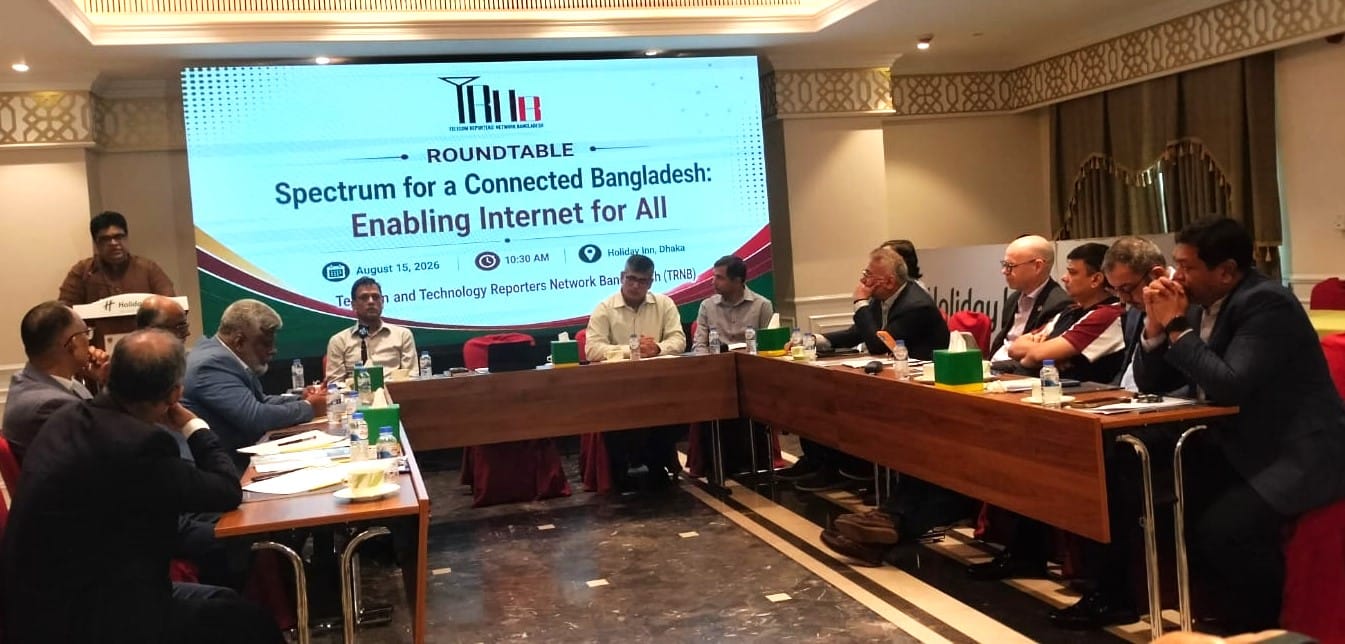
Bangladesh should stop treating mobile spectrum primarily as a source of government revenue and instead regard it as critical digital infrastructure capable of supporting economic growth, industry leaders and telecom experts have said.
The call came at a roundtable in Dhaka organised by the Telecom and Technology Reporters’ Network (TRNB), as operators prepare for the renewal of spectrum in several key frequency bands from November.
Prime Minister’s Adviser for Posts, Telecommunications and Information Technology Rehan Asif Asad told the gathering that operators should not be overly concerned about the upcoming renewal process.
“Please do not be tensed,” he said, arguing that only about 79.4 MHz of the 406 MHz currently assigned to four mobile operators is due for renewal in 2026.
The renewal process is expected to begin in November and continue in stages through 2034.
But the wider debate over spectrum costs has intensified, with operators warning that high charges are limiting their ability to invest in networks and improve service quality.
Spectrum costs under scrutiny
Industry representatives said Bangladesh’s spectrum-related costs remain well above international norms. They cited research indicating that spectrum payments account for at least 16% of operators’ revenue in Bangladesh, compared with about 10% across the Asia-Pacific region and 8% globally.
Robi’s Chief Corporate and Regulatory Officer Shahed Alam put the gap at roughly 15-18% of revenue for Bangladeshi operators, against about 7% internationally.
Participants said several countries, including India, Pakistan and Vietnam, have reduced spectrum charges in recent years. They argued that Bangladesh’s pricing framework, largely established around 15 years ago, no longer reflects the economics of a market increasingly dependent on data and high-speed connectivity.
Association of Mobile Telecom Operators of Bangladesh (AMTOB) President and Robi chief executive Ziad Shatara said the industry had changed substantially since the early days of mobile communications, when voice services dominated.
Operators today must provide far greater network capacity and speeds, he said, while their profitability has weakened.
Banglalink Chief Corporate and Regulatory Officer Taimur Rahman said spectrum costs represented about 18% of revenue for operators, making it harder to recover the cost of network investment.
He pointed to Pakistan, where spectrum prices have been cut by more than half, and called for Bangladesh to adopt a longer-term approach.
Economic gains could be substantial
The industry argues that cheaper spectrum could deliver benefits beyond the telecom sector.
According to figures presented at the event, aligning Bangladesh’s spectrum prices more closely with regional levels could help expand 5G coverage to as much as 99% of the population by 2035 and add about $34 billion to the economy.
Matching global average pricing could potentially increase the economic benefit to around $45bn, participants said.
The potential gains would come through stronger digital services, including e-commerce, financial technology, cloud computing, artificial intelligence, digital content and the Internet of Things.
Grameenphone chief executive Yasir Azman said the economics of telecom could no longer be assessed by considering spectrum, taxation and revenue sharing separately.
He said connectivity now underpins a wide range of industries, including financial services, education, manufacturing and online commerce, while operators are increasingly dependent on data services as traditional margins decline.
The key question, he said, should be what consumers receive after operators acquire spectrum — including network coverage, affordable smartphones and reasonably priced data.
Government signals broader approach
Mr Asad said spectrum should be treated as a national resource and a strategic tool for connectivity, productivity and digital inclusion rather than simply a means of raising public revenue.
He said the Bangladesh Telecommunication Regulatory Commission, the telecom ministry and the finance ministry would have to follow the existing process before decisions on spectrum pricing could be taken.
He also backed greater spectrum sharing, alongside infrastructure sharing, to make better use of existing resources.
The adviser said affordability of devices was another major barrier to digital inclusion. Around half of Bangladesh’s mobile users, he said, still rely on 2G-enabled feature phones.
He said discussions had taken place with local handset manufacturers about producing smartphones at substantially lower prices. Manufacturers had indicated that entry-level Android devices could potentially be produced for about Tk5,000-Tk6,000.
Banks have also begun offering instalment facilities for mobile phone purchases, he said, while the government is considering tax and duty support for locally produced low-cost devices.
Mr Asad suggested that the Service and Universal Fund could potentially be used to support low-income users and public Wi-Fi initiatives.
He also highlighted the growing importance of submarine connectivity. Bangladesh’s peak submarine capacity requirement is currently about 12.1 terabits per second and could rise to roughly 30Tbps by 2030. The government is examining plans to build at least 50Tbps of capacity, with additional redundancy and routes.
Regulator calls for industry study
BTRC chairman Major General Md Emdad Ul Bari (retd) said Bangladesh needs an independent, detailed study of the mobile industry before making major decisions on spectrum pricing.
He said the regulator had asked the industry to undertake such research for the past two years but no comprehensive study had been completed.
The BTRC has now commissioned its own research, although the chairman acknowledged that completing a detailed assessment before the approaching auction and renewal deadlines would be difficult.
He urged AMTOB and the Foreign Investors’ Chamber of Commerce and Industry (FICCI) to examine how business opportunities could be expanded alongside the country’s digital transformation.
The objective, he said, should be to strike a balance between consumers, businesses and the government.
Bangladesh currently has about 2.29 MHz of spectrum per million subscribers, according to the chairman, towards the lower end of international benchmarks. Future 5G networks could require substantially more capacity, with national demand potentially reaching about 1,500 MHz by 2035.
The chairman said spectrum prices should therefore be assessed not only on the basis of government receipts but also on network efficiency, service quality, affordability and the wider economic impact.
Industry seeks investment-friendly policy
Telecom expert Md Munir Hasan, who presented the keynote paper, said Bangladesh’s spectrum policy had historically placed heavy emphasis on revenue generation.
He argued that the approach had contributed to structural problems including limited spectrum availability, inadequate fibre infrastructure, restricted access to tower sites and high operating costs.
Bangladesh ranked 93rd globally for mobile network performance in 2025, he said, underlining the need for a broader policy rethink.
Industry representatives said spectrum prices should potentially be reduced to less than half their present levels, taking account of international benchmarks, operator investment capacity, consumer demand and the country’s economic priorities.
They stressed that the objective should not simply be cheaper spectrum, but a policy framework that allows operators to invest in coverage and capacity while improving affordability and service quality.
With demand for mobile data expected to rise and technologies such as AI, cloud computing and satellite connectivity developing rapidly, speakers said Bangladesh faces a strategic choice.
The country can continue to maximise short-term spectrum revenues, they argued, or use spectrum policy as a lever to accelerate digital adoption, attract investment and support long-term economic growth.
The consensus at the Dhaka meeting was clear: spectrum is no longer simply a telecom asset. In an increasingly digital economy, how Bangladesh prices and allocates it could have consequences far beyond the mobile phone industry.