


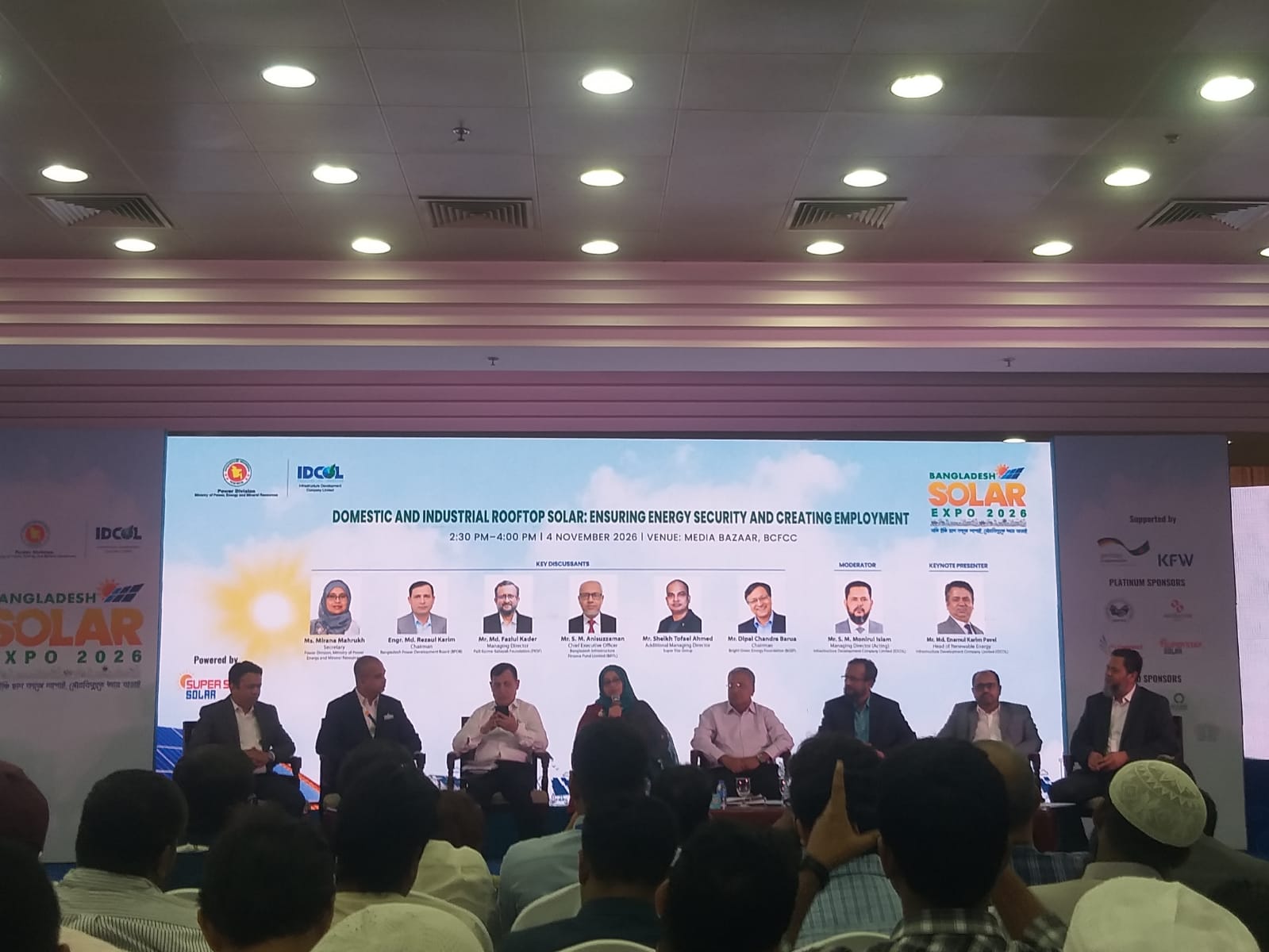
Bangladesh can generate its targeted 5,500MW of electricity from rooftop solar by 2030 by addressing financial, technical and security issues linked to installation of solar panels at households and industries, policy makers and renewable energy experts said on Wednesday.
The country has set the target as a quick fix for the energy crisis it is now going through due to escalating tensions in the Middle East, with offering incentives, legal protection and financial support to get at 3,000-4,000MW rooftop solar power before the next Summer.
At a seminar on ‘Domestic and Industrial Rooftop solar: Ensuring Energy Security and Creating Employment’ on Wednesday, the speakers said the key challenges lie in luring people for it while ensuring quality of the equipment to make the programme sustainable.
Power Division Secretary Mirana Mahrukh said the government is set to enact a new law to provide legal protection to rooftop solar and at the same time provide financial and security support.
She said, “The finance ministry has already allocated Tk 1,500 crore to encourage rooftop solar and the government is trying manage more funds from the development partners so that households and industries can have access to easy lending.”
The World Bank has promised for $500 million and another $500 million is expected to come from the AIIB, she pointed out adding that they were also trying to convince the Asian Development Bank to create a development fund for this.
Bangladesh Power Development Board Chairman Engr Rezaul Karim doesn’t think that it would be an uphill task to get 3,000-4,000MW of rooftop solar power before the next peak irrigation season in March and April.
“But there are two challenges for that one is related to financing and the other is technical. The government has already announced Tk 10.50 per unit feed in tariff for next three years, but ensuring net metering is a big challenge for the BPDB,” he said.
However, he assured that they have already taken necessary preparation for that by shortening the net metering application processing period and transforming single and three-phase meters into bi-directional to resolve the net metering issue.
The bi-directional meters counts the subscriber’s power consumption and at the same time the volume of excess electricity of the consumers going to the national grid.
The BPDB chairman also suggested the potential rooftop solar investors to keep provision for at least 20 percent battery back up to avoid any grid related complexities and get 3-4 hours electricity support after the sunset.
In his keynote paper, Md Enamul Karim, head of renewable energy at IDCOL, said the country has the potential for at least 30,000MW of rooftop solar if half of pucca or semi pucca households can be brought under rooftop solar.
In particular, the second, third and fourth tier consumers can benefit from this and their per unit power cost will be Tk 6.50 in contrast to Tk8.93-Tk10.10 paid for conventional electricity generated through fossil fuel, he showed.
PKSF Managing Director Md Fazlul Kader assured that his organization will provide financial support to household rooftop solar programme through its partner organisatioins, which have experience in carrying out such solar related schemes across the country.
Howerver, he warned that the quality of solar equipment must be ensured through strict monitoring to make the programme sustainable. He also thinks that private money should spontaneously come to such initiative. “Only the incentive-based programme may distort the market.”
SM Anisuzzaman, chief executive officer at BIFFL, a state owned financing agency said financing is not a big problem as they had already provided money to private power producers earlier.
Apart from government supports, businessmen should get long-term loans at low interest rates, he said, adding that they can also follow OPEX model involving a third party to invest in rooftop solar at their industry premises.
Speaking on the occasion, Dipal Chandra Barua, chairman of Bright Green Energy Foundation, said households should be encouraged to generate their own power, otherwise the state has to incur losses from costly power generation.
He believes that the renewable energy ordinance be a big push to that end while it has been a wise decision to offer Tk 10.50 feed in tariff for rooftop solar.
Sheikh Tofael Ahmed, additional managing director of Super Star Group, told the seminar that responses for household or industrial solar power gained a big momentum over the last few months after the government announced the programme.
SM Monirul Islam, IDCOL’s acting managing director, moderated the seminar held on the closing day of two-day Solar Expo 2026 held at the Bangladesh-China Friendship Conference Centre.