


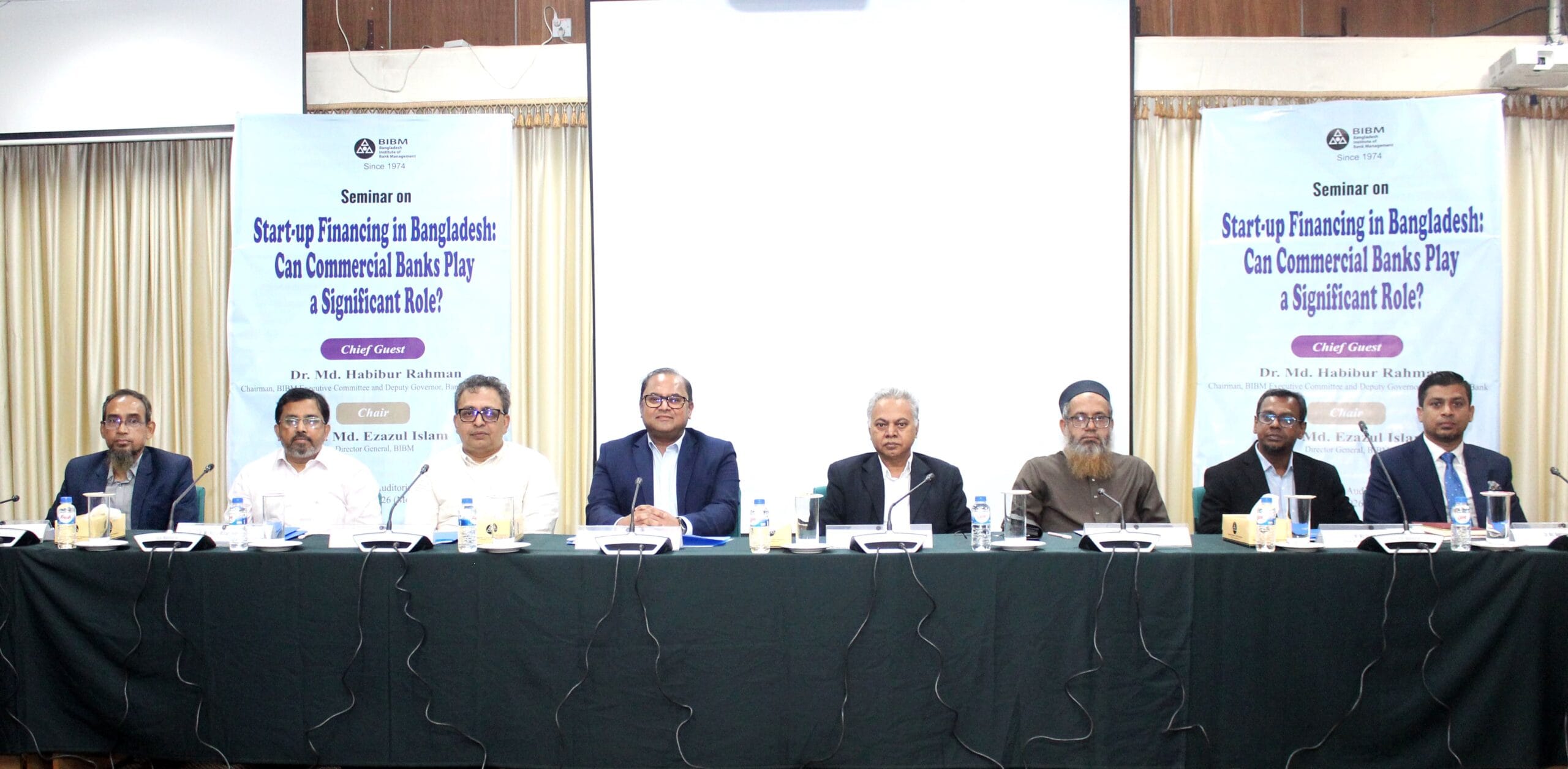
at a seminar held at the Bangladesh Institute of Bank Management (BIBM) on Monday.
The seminar, titled “Start-up Financing in Bangladesh: Can Commercial Banks Play a Significant Role?”, was held at the BIBM Auditorium in Mirpur, Dhaka. It focused on the challenges and opportunities in financing the country’s emerging startup sector and the role commercial banks can play in supporting its growth.
Dr Mohammad Habibur Rahman, chairman of the BIBM Executive Committee and deputy governor of Bangladesh Bank, attended the seminar as chief guest. In his opening remarks, he stressed the need to expand appropriate financing facilities for startup ventures and create a supportive financial environment for innovative and promising businesses.
BIBM Director of Research, Development and Consultancy and Professor Mohammad Shihab Uddin Khan delivered the welcome address.
A research team from BIBM presented the keynote paper. The team comprised Associate Professor Dr Mohammad Mosharraf Hossain, Associate Professor Dr Shamsun Nahar Momtaz, Assistant Professor Tahmina Rahman and Lecturer Benjir Ishaq. They were joined in presenting the paper by Mohammad Mohsinur Rahman, executive vice-president and head of SME Banking at Prime Bank PLC.
The presentation was followed by an open discussion. Panellists included BIBM Professor and Director of Training Dr Mohammad Tajul Islam; Syed Abdul Momen, additional managing director and head of SME Banking at BRAC Bank PLC; Naushad Mostafa, director of the SME and Special Programmes Department at Bangladesh Bank; Mohammad Manzur Mohammad Shahriar, project director of the Digital Entrepreneurship project under the ICT Division of the Ministry of Posts, Telecommunications and Information Technology; and A.K.M. Fahim Mashrur, chief executive officer and co-founder of Bdjobs Limited.
The seminar was chaired by BIBM Director General Dr Mohammad Ejazul Islam.
In his closing remarks, Dr Islam said conventional collateral-based or existing cash-flow-based lending models may not always be suitable for financing startups. The prospects of such businesses often depend on new ideas, technology, data, human resources, intellectual property and future business growth, he noted.
He said startup financing requires a different approach, but this should not mean compromising the prudent lending practices of conventional banking. Instead, banks need to strengthen their assessment capabilities through greater use of financial and transactional data, specialised credit-assessment expertise, relationship-based banking and a clearer understanding of the different stages of startup development.
Dr Islam said commercial banks could play a more significant role in startup financing if appropriate risk-sharing mechanisms were put in place. Credit guarantees, refinancing facilities, co-financing arrangements and effective links between banks, incubators, investors and government programmes could help promising startups move from the innovation stage to a level where they become eligible for bank financing.
He stressed that building a sustainable startup financing ecosystem would require coordinated efforts by commercial banks, Bangladesh Bank, government agencies, investors and entrepreneurs. No single institution can bridge the financing gap on its own, he said.
The BIBM director general said an effective financing system should enable promising startups to progress gradually from early-stage support and risk capital to sustainable commercial financing as their business models mature.
Bankers, researchers, policymakers, entrepreneurs and other stakeholders attended the seminar.