


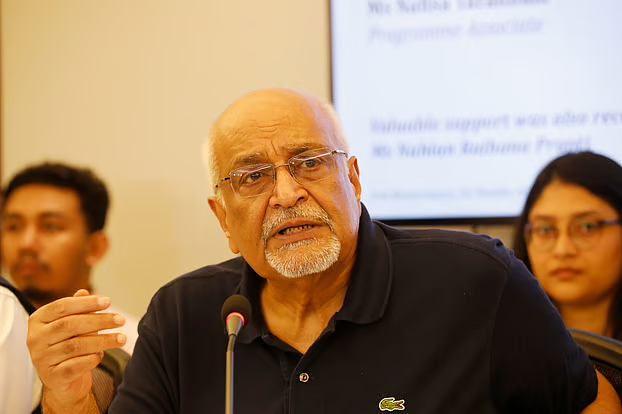
The government’s delay in taking a decision on a new pay structure for public servants could make the situation increasingly difficult, economist Debapriya Bhattacharya said on Monday.
“The government has not been able to take a decision on pay and allowances even in six months. If the issue is kept hanging, the problem will not go away. Rather, the situation will become more complicated with every passing day,” he said.
Debapriya, a distinguished fellow of the Centre for Policy Dialogue (CPD), made the remarks at a media dialogue organised by the CPD at its Dhanmondi office to assess the new government’s performance during its first six months.
He said the government appeared to lack the political courage to introduce a new pay structure, with fiscal capacity being one of the major constraints.
“The revenue collection target for the current fiscal year is Tk 6.95 lakh crore. We expect a shortfall of Tk 1.40 lakh crore from that target,” he said.
Debapriya said the report on a new pay structure prepared by the previous interim government had recommended implementing it in phases.
“Everyone had agreed to the phased implementation. It would have been better if the government had introduced a 20-25 percent dearness allowance at the beginning and sought time for implementing the full pay structure,” he said.
The delay, he warned, could affect other government activities as well.
Nearly 62,000 jobs lost
The CPD said 95 factories in three major industrial areas were permanently shut between January and August this year, resulting in the loss of 61,881 jobs.
Debapriya said the government inherited several structural problems when it took office, while the global economic environment was also unfavourable.
However, he criticised the government for failing to prepare a comprehensive baseline document outlining the economic and institutional situation it inherited.
“The government repeatedly says it took charge in a difficult situation. But there is no comprehensive, evidence-based document showing what the situation was when it assumed office,” he said.
This has made it difficult to assess the government’s measures and economic performance, as well as to reconcile official statements with available statistics, he added.
Economic recovery, governance
Debapriya said the new government had two major expectations to fulfil — economic recovery and establishment of good governance.
“There is some discomfort in both these areas,” he said, adding that the government also lacked a coordinated action plan for implementing its reform agenda.
Many of the commissions promised in the election manifesto have also not been formed or implemented, he said.
The CPD has identified around 362 government measures to assess its performance against its election pledges and policy commitments, according to Debapriya.
These measures have been divided into nine broad areas under the CPD’s “Reform Tracker” initiative.
Of the 105 governance-related developments reviewed, the CPD identified several positive measures, including the decision by lawmakers not to take government plots and vehicles, the swift trial in the Ramisa murder case and an initiative to improve traffic management using artificial intelligence.
However, the appointment of politically connected individuals to senior government positions was a matter of concern, Debapriya said.
He also criticised the government for failing to fully uphold its pledge to ensure merit-based appointments to public positions.