


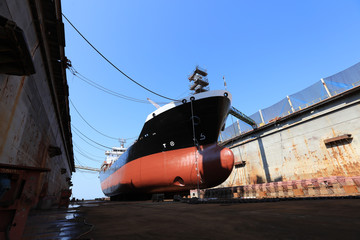
Bangladesh plans to set up a modern dry dock at Matarbari to repair and maintain large ocean-going vessels, reduce reliance on foreign shipyards and transform the emerging deep-sea port area into a regional maritime and industrial hub.
The initiative is part of the government’s wider plan to develop Matarbari and Moheshkhali as an integrated centre for port operations, logistics, energy and manufacturing under the Moheshkhali Integrated Development Authority (MIDA).
A government technical committee has recommended around 96 acres beside the Matarbari coal-fired power plant for the proposed facility, according to official sources linked to MIDA’s development.
The recommendation is not a final site approval. The proposed location must be assessed alongside other planned developments, including a coal transshipment terminal, power-sector infrastructure and an ammonia storage facility.
Meanwhile, a separate proposal for a much larger green dockyard and shipbuilding complex is being considered under a public-private partnership (PPP) arrangement.
The case for a dry dock is closely linked to the capacity of the planned deep-sea port, which is expected to handle large ocean-going vessels more than 200 metres long with a draft exceeding 10 metres. The technical committee found that no existing dockyard in Bangladesh has the capacity to dock and repair vessels of this size.
Without suitable repair facilities nearby, ships calling at Matarbari may have to travel overseas for major maintenance, increasing costs and operational delays.
A modern dry dock could allow repairs to be undertaken locally, save foreign exchange, reduce vessel downtime and create business opportunities in marine engineering, equipment supply and logistics. It could also make the port more attractive to international shipping lines.
“Ships more than 200 metres long and with a draft of over ten metres will enter the deep-sea port area, and no other dockyard in Bangladesh has the capacity to dock and undock them for repair,” said a government high-up familiar with the matter, seeking not to be named.
He said ship repair capability is an essential part of any sea port, adding that without repair facilities, commercial ships may be reluctant to use the Matarbari deep-sea port.
“As there is no convenient dockyard in Bangladesh for repairing such ships, the shipping company would have to take this facility from another country, which will not be sustainable in the long run,” the official added.
Site selection and development rationale
The technical committee favoured the proposed site because of its proximity to the sea, an existing breakwater and a deep navigational channel. Using the channel could avoid additional dredging, reducing construction costs and potential environmental impacts. Its proximity to the port would also allow vessels to reach the repair facility quickly.
The committee examined how the dockyard could be developed without disrupting the power plant’s operations, particularly its water-discharge pipelines. It suggested that the pipelines could be routed around the proposed site, subject to appropriate technical arrangements.
MIDA is coordinating the broader development of Matarbari and Moheshkhali, including the deep-sea port, power and energy installations, industrial zones, logistics facilities and supporting infrastructure.
At its first governing board meeting in January, the authority stressed that the dockyard site should be selected in consultation with the Power Division and that the power plant’s water-discharge system must remain protected.
An eight-member technical committee, chaired by Commander Junaid Mahmud, MIDA’s director for ports, logistics, marine safety and enforcement, subsequently inspected the area and reviewed the master plan, land records and maps.
Representatives of the Power Division, the Coal Power Generation Company Bangladesh Ltd (CPGCBL), Chattogram Port Authority (CPA), Cox’s Bazar administration and the JICA technical assistance team were involved in the process.
Land-use conflicts and safety concerns
The proposed 96-acre site includes government khas land and land associated with the power plant, while parts of the wider area are submerged or sandy and their ownership status requires clarification.
Competing demands for land have complicated the proposal. The Power and Energy Division is reviewing a plan for a coal transshipment terminal in the area, although its location and land requirement have yet to be settled.
The technical committee recommended deciding the terminal’s location first and considering an alternative site for the dockyard if both projects cannot be accommodated.
Safety concerns also surround a proposed ammonia storage facility. Around four acres within the broader area have been earmarked for an ammonia tank linked to the second phase of the Matarbari power project.
Ammonia is expected to be used in a selective catalytic reduction system to reduce nitrogen oxide emissions, although the final decision on the technology for units 3 and 4 remains pending.
The committee warned that ammonia could pose fire and explosion risks. It recommended a comprehensive feasibility assessment covering risk management, safety clearances, fire protection, emergency evacuation, staff training and potential impacts on neighbouring installations and the environment before the site is finalised.
The CPA has also proposed a commercial ship-repair facility, while CPGCBL, which controls part of the land, has raised objections to the use of its property. Coordination among the agencies will be necessary to settle land use, access and safeguards for existing infrastructure.
Separate $1 billion PPP proposal
The Ministry of Shipping has given in-principle approval to an unsolicited proposal for a $1 billion Matarbari Green Dockyard and Shipbuilding Facility, backed by Australia-based AIS Marine Investments, with China Harbour Engineering Company as the proposed technical partner. The proposal has been sent to the Public-Private Partnership Authority for technical and financial appraisal.
The project envisages a facility on about 200 acres of CPA-owned land under a landlord-model PPP, including a proposed dry dock measuring 600 metres by 95 metres. The port authority would retain ownership of the land and fixed assets, while the investment would be privately financed. The project remains subject to appraisal and further approval.
The 200-acre PPP proposal is separate from the technical committee’s recommendation for a 96-acre site. Their relationship, including the final land requirement and agencies’ responsibilities, remains to be clarified.
MIDA has meanwhile included a dockyard or shipyard among nine priority projects under its jurisdiction, with implementation activities targeted for acceleration by 2029. A high-level coordination committee has been formed to expedite land acquisition, compensation, rehabilitation and project implementation.
Wider economic ambitions
MIDA’s master plan envisages a broader transformation of Matarbari and Moheshkhali into an industrial and commercial hub. Projections presented to its governing board suggest that full implementation could attract around $65 billion in investment, including about $5 billion in foreign direct investment, and add approximately $150 billion to GDP over the long term.
The plan also projects 150,000 direct and 2.5 million indirect jobs. These are long-term projections, not secured investments or guaranteed employment.
The plan covers port and logistics facilities, industrial and manufacturing zones, power and energy infrastructure, fisheries processing, residential areas and supporting services. Roads, drainage, housing and utilities are also intended to support the proposed industrial expansion.
For the dry dock to become part of this transformation, the government must resolve competing land demands, complete technical and financial assessments and ensure that the facility does not compromise the safety or operation of existing infrastructure.
If these challenges are addressed, the project could help establish Matarbari as a centre for ship repair and maritime engineering, extending the economic benefits of the deep-sea port beyond cargo handling.