


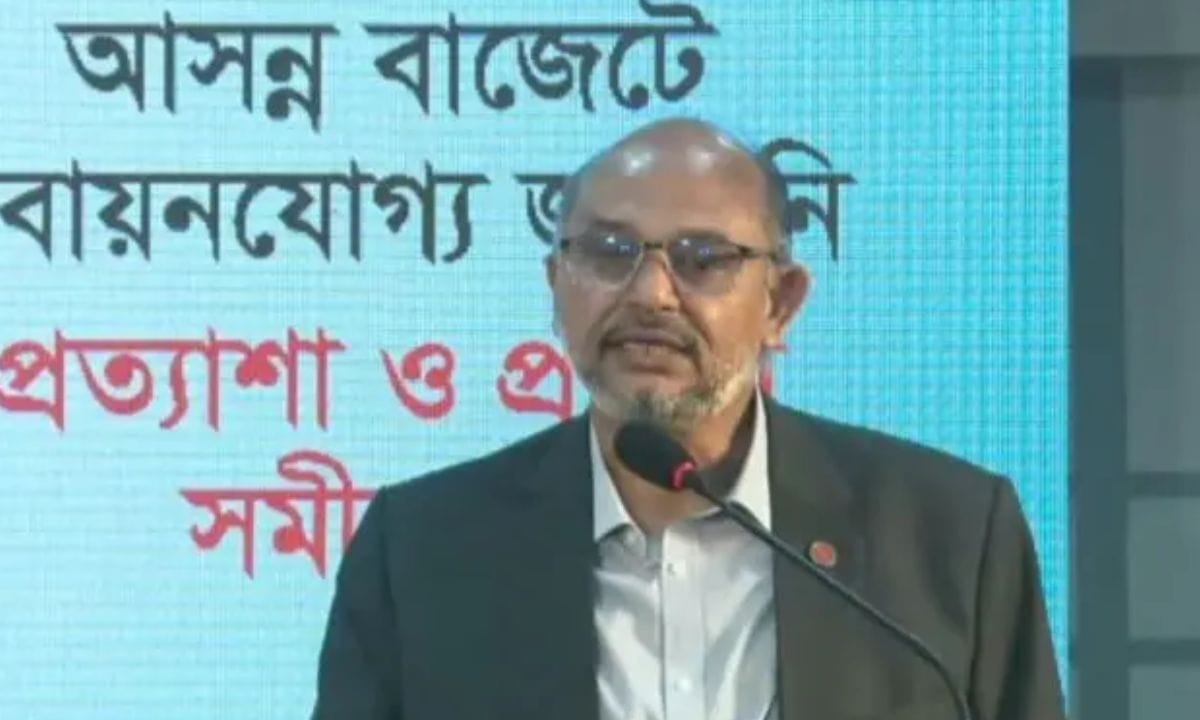
Prime Minister’s Economic Affairs Adviser Dr Rashed Al Mahmud Titumir on Sunday said Bangladesh’s energy sector is caught in a “vicious cycle,” with a growing gap between installed capacity and its effective utilisation leading to a significant waste of public resources.
Speaking at a dialogue titled “Renewable Energy in the Upcoming Budget: Balancing Expectations and Outcomes” in the capital, he noted that despite substantial expansion in power generation capacity, the country has failed to ensure its efficient use.
This mismatch, he said, is forcing the government to bear a heavy burden of capacity payments.
The event was jointly organised by the Centre for Policy Dialogue (CPD) and Dhaka Stream.
Titumir said that while building capacity in anticipation of future demand is a standard business practice, many of Bangladesh’s power agreements were concluded without proper adherence to rules and regulations, and were later granted legal protection. “This has compounded inefficiencies in the sector,” he added.
He also stressed that the country did not develop the necessary energy infrastructure required to reduce dependence on fossil fuels and ensure environmental sustainability.
As a result, Bangladesh is now facing multiple challenges simultaneously, including rising costs and energy security concerns.
Referring to ongoing geopolitical tensions in the Middle East, Titumir said the resulting surge in global energy prices has put additional pressure on Bangladesh, despite the country having no role in creating the situation.
While conventional economic theory suggests price adjustments, he noted that such measures are difficult for an accountable government as they tend to fuel inflation.
The adviser said inflation had eased somewhat during Ramadan but has recently picked up again, partly due to energy price adjustments.
However, he pointed out that the extent of price hikes remains modest compared to the level of subsidies provided.
Titumir hinted that the government is considering five key initiatives for the energy sector but declined to disclose details, saying they would be revealed in due course.
Outlining long-term goals, he said Bangladesh aims to become a trillion-dollar economy by 2034, which would require a major overhaul of its energy structure and mix, including a significant increase in the share of renewable energy.
He added that electricity pricing would be aligned with the income levels of both industrial users and general consumers.
At the same time, efforts would be made to reduce import dependence in the renewable energy sector by building domestic production capacity.
Titumir further alleged that the power and energy sector had previously been pushed towards an “oligarchic system,” weakening the country’s energy security.
He criticised past import-dependent policies, saying they had hindered the development of local capacity, the consequences of which are now becoming increasingly evident.