


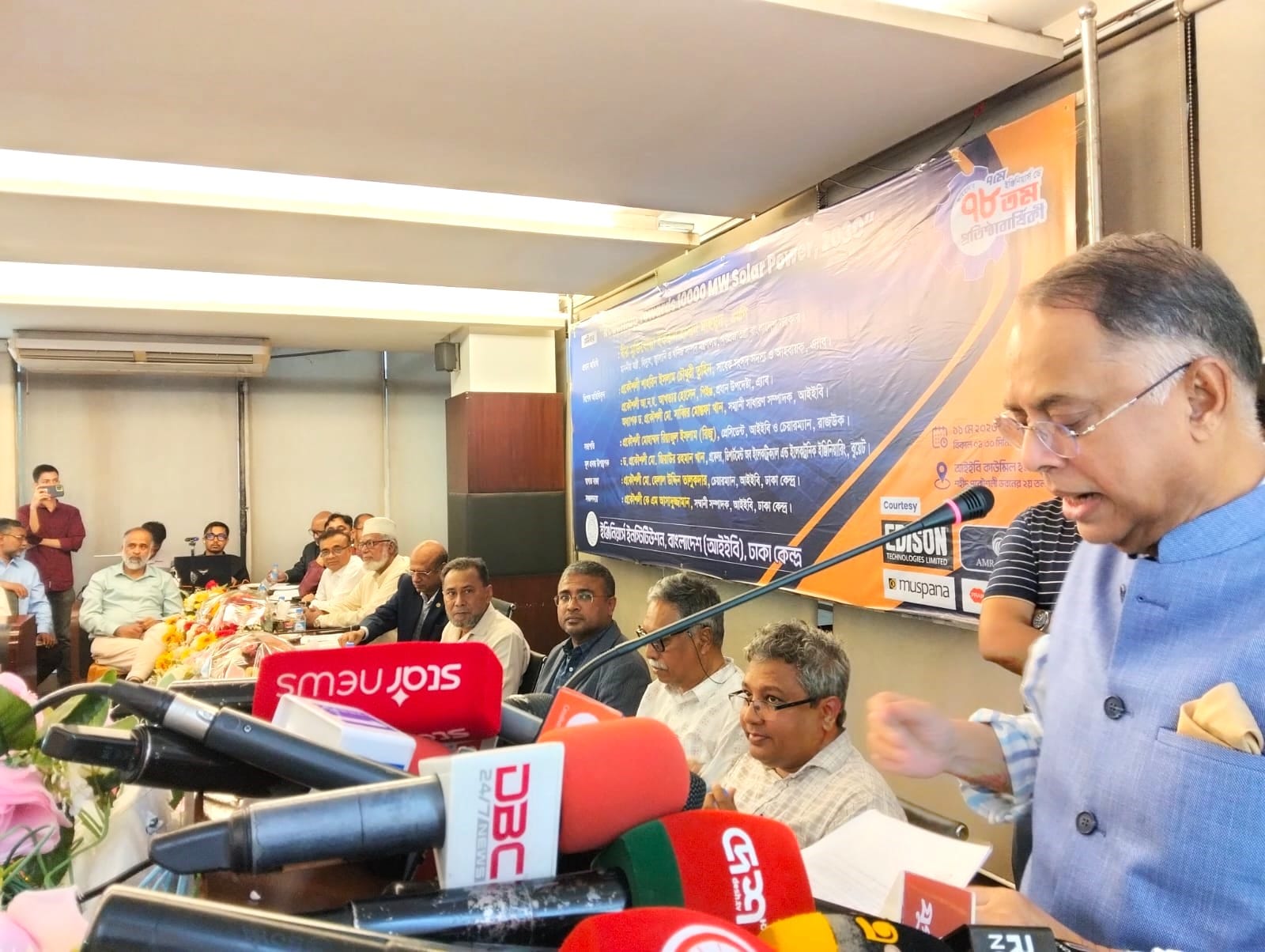
The government plans to generate 5,000 megawatts of electricity from solar energy within the next five years as the government seeks to reduce dependence on imported fuel and expand renewable power generation, the Power and Energy Minister has said.
Speaking at a seminar in Dhaka on Monday, Iqbal Hasan Mahmud said the government had made solar energy a central priority in its power strategy and was preparing a roadmap to sharply increase generation capacity by 2030.
“If Pakistan can generate 27,000 megawatts of electricity from solar power, Bangladesh can do it as well,” he told the audience.
The remarks were made at a seminar titled “Roadmap Towards 10,000 Megawatts of Solar Power by 2030”, organised by the Dhaka Centre of the Institution of Engineers, Bangladesh as part of the body’s 78th anniversary celebrations and Engineers Day observances.
Mr Mahmud said Prime Minister Tarique Rahman had raised the issue of solar power during the second meeting of the new cabinet and asked officials to prepare a concrete national strategy for expanding renewable energy production.
The minister accused the previous administration of maintaining an import-dependent energy system that had left the sector burdened with liabilities of around Tk560bn (£4.1bn). He alleged that irregularities had occurred under the earlier model and said some of those practices had yet to be fully eliminated.
He also criticised previous rooftop solar requirements for new buildings, arguing that many installations had been carried out only nominally and were not effectively used.
“Panels were installed merely for show,” he said. “Now they are lying covered in dust.”
Mr Mahmud outlined plans for a commercially driven rooftop solar scheme in Dhaka and other cities, under which private investors would be allocated specific zones to generate and sell electricity independently.
“The government will not interfere,” he said, adding that bureaucratic delays often slowed infrastructure projects.
The minister called for temporary tax exemptions on imported solar panels and solar-related equipment to encourage investment and accelerate adoption. He also proposed incentives for homeowners, including reductions in holding tax for households installing rooftop solar systems.
“That could trigger a revolution in solar energy,” he said.
The government is additionally considering the installation of solar panels on unused public land, including railway property, roadside land and state-owned plots managed by the Ministry of Land.
The seminar’s keynote paper was presented by Professor Dr Md Ziaur Rahman Khan of the Department of Electrical and Electronic Engineering at Bangladesh University of Engineering and Technology.
He said renewable energy currently accounted for around 5% of Bangladesh’s electricity generation, but the government aimed to increase the share to 30% by 2030. Achieving that target would require expanding solar generation capacity from roughly 1.5 gigawatts to 10 gigawatts within a relatively short period.
The paper examined solar expansion in Vietnam, India and Pakistan, concluding that rapid growth depended on strong grid infrastructure and supportive policy frameworks. Vietnam, for example, added 16.5 gigawatts of solar power within two years, though inadequate grid capacity reportedly led to significant energy wastage.
India, by contrast, was cited as a successful example of reducing solar generation costs through competitive auctions and “plug-and-play” infrastructure systems.
For Bangladesh, the paper highlighted solar home systems, solar-powered irrigation pumps and net metering in the garment industry as successful initiatives. However, land shortages, high import duties and lengthy approval procedures were identified as major barriers to expansion.
The study also recommended integrating solar facilities with agricultural land, developing floating solar projects on Kaptai Lake, removing import duties on solar equipment and investing in smart grids and battery storage systems.
Additional proposals included community-based solar schemes, green bonds and investment opportunities for overseas Bangladeshis.
The session was chaired by Mohammad Riazul Islam, president of the Institution of Engineers, Bangladesh and chairman of RAJUK. Other speakers included former MP and AEB convener engineer Shahrin Islam Chowdhury Tuhin, AEB chief adviser engineer A.N.H. Akhtar Hossain, and honorary secretary general of the Institution of Engineers, Bangladesh, Professor Dr engineer Md Sabbir Mostafa Khan.