


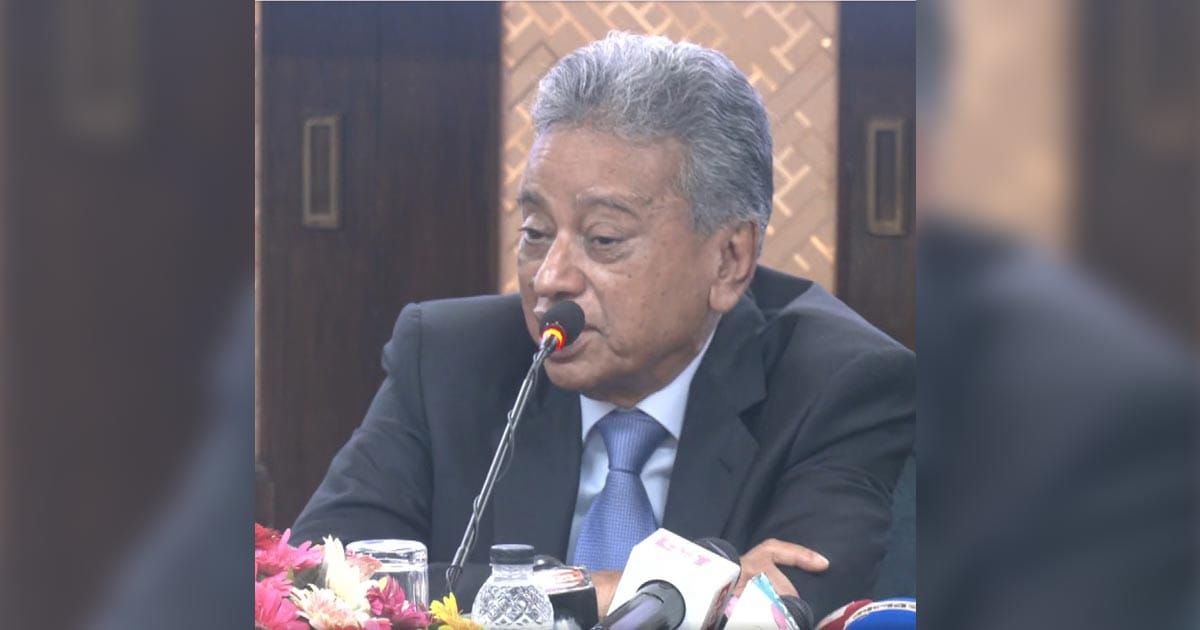
Finance and Planning Minister Amir Khosru Mahmud Chowdhury on Sunday said the government’s Family Card programme had been implemented without political consideration or partisan bias, with a pilot delivery system recording an error rate of only 1.2 percent.
He said the government would maintain the same politically neutral approach in distributing the cards in the future.
The minister made the remarks at separate events in Chattogram on post-flood recovery and rehabilitation support, where he also stressed a three-way partnership among the government, private sector and non-government organisations to improve aid delivery and curb corruption and waste.
Speaking at the inauguration of a post-flood recovery and rehabilitation assistance project at the Chattogram Circuit House, Amir Khosru said the 1.2 per cent error rate in the Family Card pilot was negligible in the Bangladesh context.
“The cards were distributed impartially and without any political consideration, and this approach will continue in the future,” he said.
He said efficient delivery systems were crucial to ensuring that relief and other forms of assistance reached intended beneficiaries.
Bangladesh had suffered significant losses in the past because of corruption, waste and weaknesses in the management of aid distribution, he said.
At another post-flood rehabilitation assistance event at Hotel The Peninsula in Agrabad, organised jointly by HSBC Bangladesh and BRAC, the minister said the government was increasingly building partnerships with private businesses and NGOs to improve service delivery.
Such cooperation was not limited to flood rehabilitation but was also being incorporated into the government’s broader economic model, he said.
The government acts as the first responder during disasters by providing immediate relief, while NGOs and the private sector can play a greater role in longer-term rehabilitation, including repairing educational institutions, assisting persons with disabilities and supporting affected communities, he added.
“The government alone faces a major challenge in ensuring that everything is distributed properly,” the minister said, adding that involving private organisations and NGOs in the delivery system could improve efficiency and reduce corruption and waste.
He said he was encouraged that, to his knowledge, no allegations of corruption had so far emerged over the ongoing flood relief and post-flood rehabilitation activities.
“I have not seen any such allegation in newspapers or elsewhere so far,” he said.
Amir Khosru said mechanisms such as the Family Card programme, along with oversight by partner organisations, were helping strengthen monitoring and prevent misuse of government resources.
He also praised the media for acting as a watchdog and contributing to greater transparency in the delivery of public assistance.
The minister thanked HSBC Bangladesh and BRAC for joining the rehabilitation initiative, saying that genuine rehabilitation of affected people was more important than simply providing immediate relief.
Government resources, combined with support and resource allocation from the private sector and NGOs, could make rehabilitation efforts more effective and ensure that assistance reached those who genuinely needed it, he said.
Divisional Commissioner Dr Md Ziauddin, Deputy Commissioner Md Zahidul Islam Miah, Chattogram Chamber of Commerce and Industry President Amirul Haque Chowdhury and CDA Chairman Engineer Belayet Hossain, among others, attended the events.