


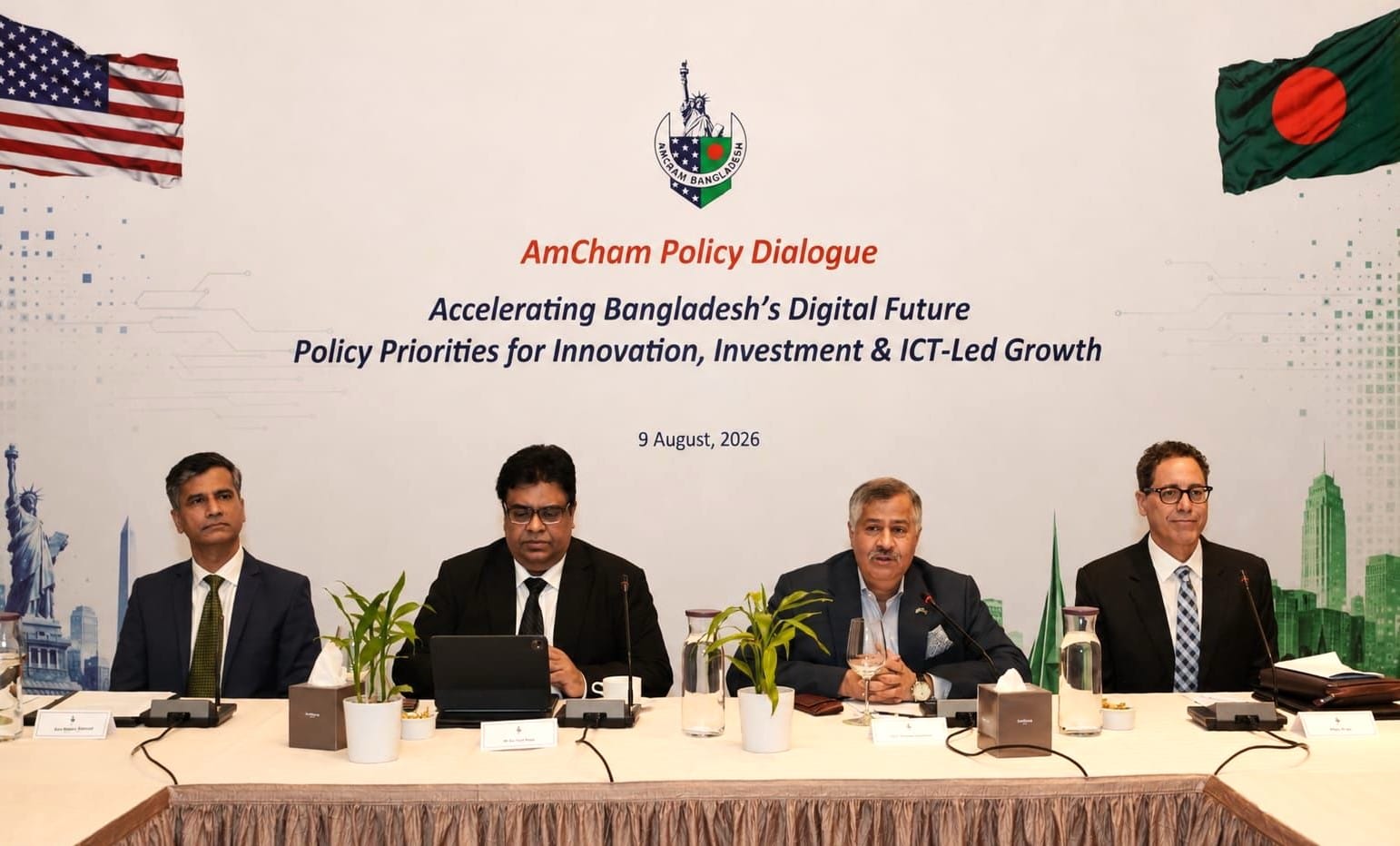
Bangladesh has unveiled a five-point policy agenda aimed at strengthening its digital economy, expanding telecom infrastructure and building the skills needed to compete in artificial intelligence and electronics manufacturing.
The priorities were outlined by Rehan Asif Asad, the Prime Minister’s Adviser on Post, Telecommunication, ICT, Science and Technology, at a policy dialogue hosted by the American Chamber of Commerce in Bangladesh (AmCham) in Dhaka on Sunday.
Speaking at the event, titled “Accelerating Bangladesh’s Digital Future: Policy Priorities for Innovation, Investment & ICT-Led Growth”, Mr Asad said the government would focus on predictable taxation, wider digital connectivity, digital public infrastructure, AI-ready skills and the development of an electronics manufacturing industry.
He highlighted the comparatively high tax burden on Bangladesh’s telecom industry, estimated at between 51% and 56%, against a global average of 22% to 27%. He said the government was pursuing a consistent, forward-looking policy framework covering five years and pointed to the removal of the SIM tax as part of efforts to support the sector.
Bangladesh is the world’s seventh-largest market by mobile subscribers, Mr Asad said, but its service quality remains well behind that of leading markets. Improving mobile and broadband connectivity, therefore, would be a central government priority.
He cited UN and International Telecommunication Union findings that a 10% increase in broadband penetration can raise national GDP by about 1%, underlining the wider economic importance of investment in digital infrastructure.
‘One Citizen, One ID, One Digital Wallet’
A major element of the government’s strategy will be the development of digital public infrastructure under the proposed “One Citizen, One ID, One Digital Wallet” model.
Mr Asad said the platform would be based on Estonia’s X-Road digital infrastructure and made available free of charge. The system is intended to connect citizens’ digital identities with bank accounts and the National Board of Revenue, potentially creating a common infrastructure for public and private digital services.
He said the platform would eventually be open to both domestic and international payment networks.
The government is also seeking to create an AI-ready workforce. Bangladesh produces an estimated 23,000 to 30,000 engineering and science graduates each year, but Mr Asad said greater emphasis was needed on artificial intelligence, cybersecurity and data skills.
The government plans to introduce such subjects into school curricula while strengthening collaboration between industry and universities.
Electronics manufacturing was identified as a further potential growth sector. Mr Asad said Bangladesh should consider incentives similar to those that helped establish the country’s garment industry, pointing to Vietnam’s consumer electronics exports, which he said rose from about $1bn to $217bn in a decade.
Business leaders press for regulatory changes
The dialogue, moderated by Rubaba Dowla, chair of AmCham’s ICT Subcommittee and Oracle’s country managing director for Bangladesh, Nepal and Bhutan, brought together senior representatives from the technology, financial services and digital sectors.
Representatives from companies including Citibank, Cisco, HSBC, Mastercard, MetLife, Pathao, PwC, Standard Chartered Bank, ShopUp and Visa raised a series of regulatory and infrastructure concerns.
Among the proposals was the introduction of open-loop ticketing for metro rail and toll systems, allowing international payment networks to be used alongside domestic systems.
Business leaders also called for Bangladesh’s Bangla QR payment system and the proposed digital wallet infrastructure to be opened to international payment networks.
Other concerns included a 15% VAT waiver under the National Board of Revenue’s Startup Sandbox, which industry representatives warned could create unintended anti-competitive effects.
The business community also urged the government to align its cloud-computing policy for banks and non-bank financial institutions with the Personal Data Protection Act (PDPA), enabling regulated financial institutions to make greater use of public cloud services.
Participants called for the early establishment of a National Data Governance Authority, stronger legal recognition of digital signatures and electronic agreements, improved national cybersecurity and closer industry-academia cooperation to address shortages of AI and data-engineering specialists.
Cybersecurity and submarine cables among immediate priorities
Responding to the concerns, Mr Asad said RFID-based automated toll collection was already being tested.
He said Bangladesh Bank had agreed, as a first step, to allow Bangla QR to receive international inward payments. The proposed “One Citizen, One ID” platform would also be open to domestic and international payment networks, he said.
The government would review and fine-tune the Startup Sandbox provisions in consultation with the wider startup community.
Mr Asad identified national cybersecurity as an immediate priority and said work on a national AI policy would begin in the fourth quarter. The policy would be developed by a joint group involving government, businesses, academics and researchers.
He also warned that Bangladesh faces an urgent need to expand submarine cable capacity.
The country’s current capacity is about six terabytes, compared with peak national demand of roughly 12 terabytes, while traffic is doubling every two years, according to Mr Asad. New submarine cables can take two to three years to build, making long-term planning essential to maintaining the country’s digital infrastructure and sovereignty.
AmCham calls for greater investor involvement
Opening the dialogue, Syed Mohammad Kamal, president of AmCham and vice-president of Mastercard, welcomed the government’s ratification of the Personal Data Protection Act, saying the final legislation reflected many of AmCham’s recommendations following sustained engagement during its development.
He also welcomed measures in the Finance Act 2026, including tax exemptions for freelancers and content creators and customs relief on computers, digital devices and semiconductor-related materials.
Mr Kamal called for greater clarity over the new digital permanent establishment provision linked to a 100,000-subscriber threshold. He also urged the government to reconsider the increase in the turnover tax on internet service providers from 1% to 1.5% of gross receipts.
He called for simpler inbound and outbound international payments for technology companies and startups and argued that foreign investors should have a greater role in policymaking and national business forums.
Greater participation by international investors, he said, would bring global expertise and international best practice into Bangladesh’s policy process and help create a more competitive and investment-friendly business environment.
The event concluded with a vote of thanks from Ala Uddin Ahmad, vice-president of AmCham and chief executive officer of MetLife Bangladesh.
The dialogue brought together AmCham’s executive committee, members from the ICT sector and officials from the US Embassy, reflecting growing engagement between Bangladesh’s government and the private sector over the country’s digital transformation.