


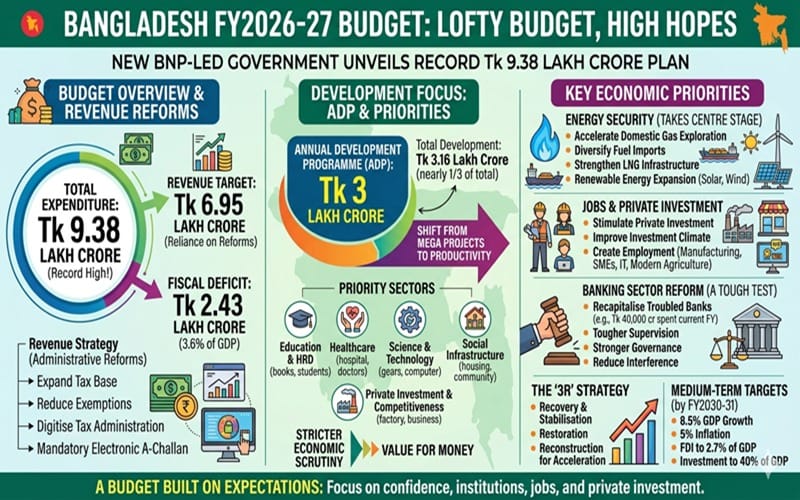
Bangladesh’s new BNP-led government has unveiled a record Tk 9.38 lakh crore budget for FY2026-27, aiming to revive economic growth while navigating a difficult balancing act of containing inflation, expanding development spending, strengthening energy security and attracting private investment.
The proposed budget is nearly Tk 1.5 lakh crore larger than the current fiscal year’s original allocation. Revenue collection target has been set at Tk 6.95 lakh crore, leaving a fiscal deficit of Tk 2.43 lakh crore, equivalent to 3.6 percent of GDP.
The proposed budget faces a familiar challenge — how to mobilise the revenue needed to finance a significantly larger spending programme without imposing excessive burdens on businesses and consumers.
The ambitious agenda comes at a time when households continue to struggle with high inflation, businesses face weak investment conditions, banks remain burdened by governance failures and the country confronts growing uncertainty in global energy markets.
The finance minister argues that the larger budget is necessary to support economic recovery, strengthen social protection, increase development spending and address growing obligations arising from debt servicing, energy imports and public services.
The budget speech repeatedly emphasised economic democratisation, deregulation, good governance and investment-led growth. It also acknowledged that Bangladesh’s economy remains under pressure from inflation, debt obligations, foreign exchange vulnerabilities and external shocks.
A major feature of the budget is the government’s decision to increase the share of development expenditure. Total development spending has been proposed at Tk 3.16 lakh crore, including a Tk 3 lakh crore Annual Development Programme (ADP), accounting for nearly one-third of total expenditure.
Reform Over Spending
The government’s economic strategy is built around a three-stage framework — Recovery and Stabilisation, Restoration, and Reconstruction for Acceleration, or the “3R Strategy”.
The immediate goal is to restore macroeconomic stability and protect vulnerable groups from inflationary pressures. Over the medium term, the administration plans to reform taxation, strengthen financial institutions, improve the business climate and revive private investment.
The government has set ambitious targets, including raising GDP growth to 8.5 percent, reducing inflation to 5 percent, increasing foreign direct investment to 2.7 percent of GDP and lifting total investment to 40 percent of GDP by FY2030-31.
Whether these targets can be achieved will depend largely on the success of reforms rather than public spending alone.
ADP Focus Shifts to Human Capital and Productivity
A notable feature of the proposed budget is the increased emphasis on development spending.
The Annual Development Programme (ADP) has been set at Tk 3 lakh crore, while total development expenditure will reach Tk 3.16 lakh crore.
The government plans to increase the share of development spending in total expenditure from 27.3 percent in the revised FY26 budget to nearly 34 percent in FY27, while reducing the share of operating expenditure.
Unlike previous years, the budget places less emphasis on launching large flagship projects and more focus on sectors viewed as critical to long-term productivity.
Education, healthcare, science, research, technology and human resource development have been identified as key priorities.
The government has also prioritised infrastructure that directly supports investment and economic competitiveness, while social infrastructure receives the largest overall allocation.
Amir Khosru said future development projects will be subject to stricter economic scrutiny, cost-benefit assessments and implementation readiness tests to ensure value for money.
Revenue Mobilisation Holds the Key
The success of the budget, however, may depend less on spending plans than on the government’s ability to achieve its ambitious revenue target.
Revenue collection has been projected at Tk 6.95 lakh crore, equivalent to 10.2 percent of GDP. Of this amount, Tk 6.04 lakh crore is expected to come from the National Board of Revenue.
To achieve the target, the government is relying heavily on administrative reforms rather than major tax rate increases. Planned measures include expanding the tax base, reducing exemptions, digitising tax administration, strengthening VAT collection, improving compliance and introducing the mandatory electronic A-Challan system.
The finance minister hopes these reforms will improve collection efficiency while reducing leakages and bringing more taxpayers into the formal system.
Yet economists note that achieving such ambitious targets will require substantial improvements in compliance and administration at a time when businesses continue to face high financing costs and uneven economic recovery.
Balancing Revenue Needs and Taxpayer Concerns
One of the central challenges facing the government is increasing revenue without creating additional pressure on consumers and businesses already coping with elevated living and operating costs.
The budget speech repeatedly highlights a taxpayer-friendly approach, emphasising simplification, digitalisation and broader participation rather than relying solely on higher taxation.
However, tax experts say expanding the tax net and reducing exemptions could still increase the effective tax burden on segments of the economy that have historically remained outside the formal system.
The government’s ability to maintain public support for revenue reforms may therefore depend on whether taxpayers see corresponding improvements in public services, governance and economic opportunities.
Energy Security Takes Centre Stage
No issue appears to have shaped the budget more than energy security.
The government warned that Bangladesh remains heavily dependent on imported fuel, with most petroleum, LNG and LPG supplies originating from the Middle East. Recent geopolitical tensions have exposed the risks of that dependence, increasing import costs and creating new inflationary pressures.
For the first time in years, the budget places greater emphasis on fuel security than on power generation capacity alone.
The government plans to accelerate domestic gas exploration, diversify fuel import sources, strengthen LNG infrastructure and improve efficiency throughout the power and energy value chain.
Renewable energy also features prominently in the strategy. The administration wants to expand solar and wind power generation, modernise the national grid and introduce smart technologies to reduce long-term dependence on imported fossil fuels.
The emphasis reflects a growing recognition that energy security has become one of the country’s most significant economic vulnerabilities.
Banking Sector Reform Faces a Tough Test
The budget acknowledges the deep structural problems facing Bangladesh’s banking system.
The government disclosed that more than Tk 40,000 crore is being spent this fiscal year to recapitalise troubled banks, highlighting the scale of the crisis.
The finance minister has promised tougher supervision, stronger governance standards, reduced political interference and greater transparency in lending practices.
For many economists, the success of these reforms will be a critical indicator of whether the broader economic recovery strategy can succeed.
Growth Through Investment and Employment
Beyond fiscal management, the budget aims to stimulate private investment and employment generation.
The government has outlined plans to improve the investment climate through regulatory reforms, simplification of business procedures and measures designed to lower the cost of doing business.
Employment generation has been identified as a central objective, particularly in manufacturing, SMEs, information technology, modern agriculture and export-oriented industries.
The broader goal is to create a more investment-driven economy capable of generating jobs, raising productivity and supporting higher growth over the medium term.
A Budget Built on Expectations
The FY27 budget is as much a statement of intent as it is a fiscal document.
It seeks to reassure citizens struggling with rising living costs, businesses seeking policy stability and investors looking for credible reforms.
The government’s central message is clear: economic recovery will come not from debt-driven spending or headline-grabbing projects, but from restoring confidence, strengthening institutions, attracting investment and creating jobs.
The challenge now is translating that vision into results in an economy still weighed down by inflation, financial-sector weaknesses and growing external uncertainties.