


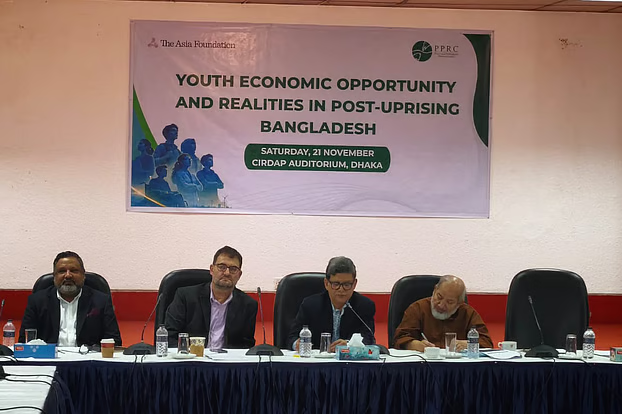
Despite abundant economic opportunities across Bangladesh, young people are struggling to turn them into jobs and businesses because of inadequate skills, financing, processing facilities and institutional support, a study by the Power and Participation Research Centre (PPRC) has found.
The study, covering five regions, reveals a disconnect between local economic potential and the support systems needed to generate employment and income.
Rajshahi produces a large share of the country’s mangoes but has little capacity to process the fruit into higher-value products. Chattogram needs skilled workers for its port, transport and healthcare sectors but lacks adequate job-oriented training.
In Noakhali, women entrepreneurs face barriers to low-interest loans, including requirements for their husbands’ signatures.
The findings were presented on Saturday at the CIRDAP auditorium in Dhaka. The study, titled ‘Meso-Economy and the Missing Middle: Why Opportunities Fail to Translate into Outcomes for Youth’, was supported by The Asia Foundation.
PPRC Chairman Hossain Zillur Rahman said the July uprising had brought economic justice into focus alongside political demands.
Young people’s aspirations for decent employment, secure working conditions and access to public services were important dimensions of the expectations emerging from the uprising, he said.
He described the meso-economy as the middle layer between the macroeconomy and household-level economic activities, where national policies and economic opportunities are translated into jobs, businesses and income—or where people become stuck.
Degrees not translating into jobs
Citing the 2024 Labour Force Survey, the study said Bangladesh had 2.62 million unemployed people, including 885,000 university graduates.
It also highlighted a widening disconnect between industrial growth and employment. Manufacturing employment declined by 9.6 percent between 2016 and 2022, although the industrial sector expanded at an annual rate of 9.1 percent.
The research was conducted between August 28 and September 25, 2026. It included consultations with young people and employers in Rajshahi, Jashore and Chattogram, questionnaire responses from 100 young people and 59 employers and entrepreneurs, and field-level discussions in five locations, including Naogaon, coastal Noakhali and Bandarban.
Regional opportunities, systemic barriers
In Rajshahi, nearly half of the country’s mango production comes from the region, but most of the fruit is sold fresh, resulting in significant post-harvest losses. Processing mangoes into dried slices, concentrates, seed butter and oil could create jobs and businesses. The silk sector also has untapped potential.
In Jashore, flower cultivation, fisheries, light engineering, women-led businesses and digital ventures offer opportunities. But financial and administrative services do not adequately meet businesses’ needs.
The study also found a shortage of IT expertise among officials managing the local hi-tech park, while a well-equipped university laboratory remains underused.
In coastal Noakhali, the absence of local soybean-crushing and animal-feed factories means raw materials leave the region without generating much local value addition. Agricultural loan instalments also often begin before farmers earn money from selling their crops.
Women face additional hurdles in accessing finance. One woman entrepreneur reportedly failed to secure a loan because her husband was unavailable to provide the required signature.
Women in other coastal and southwestern areas reported similar demands for land documents and husbands’ signatures. The study also found cases of husbands controlling loans taken in their wives’ names.
In Chattogram, port operations, industries, healthcare and digital services offer considerable employment potential. However, employers complain about a shortage of practically skilled workers, while young jobseekers say employers demand experience even for entry-level positions.
Limited internship and part-time opportunities make it harder to enter the job market. Some also alleged that informal payments were required to secure jobs.
In Bandarban, fruit orchards, coffee, cashew nuts, beekeeping, tourism and handicrafts offer livelihood opportunities. But poor roads, inadequate cold storage, limited processing facilities and weak market connections prevent producers from earning better returns.
The study also raised concerns about the environmental impact of replacing traditional jum cultivation with fruit orchards. One Mro participant said, “The state encouraged everyone to establish orchards. But the more mango trees are planted, the more water dries up.”
Seven priority areas
To address these constraints, the PPRC proposed seven priority areas, including paid apprenticeships, cost-sharing arrangements to involve employers in skills training and loan repayment schedules aligned with borrowers’ income cycles.
It recommended removing credit conditions such as land ownership documents and husbands’ signatures that restrict women’s access to finance.
Other proposals include decentralised licensing services for small businesses, assessing enterprises based on sales performance, publishing service standards, providing childcare and safe transport, expanding mother-tongue education and ensuring inclusive recruitment.
The study also called for protecting indigenous communities’ traditional knowledge, regular dialogue between policymakers and young people, a stronger role for regional chambers of commerce and effective mechanisms to address complaints.