


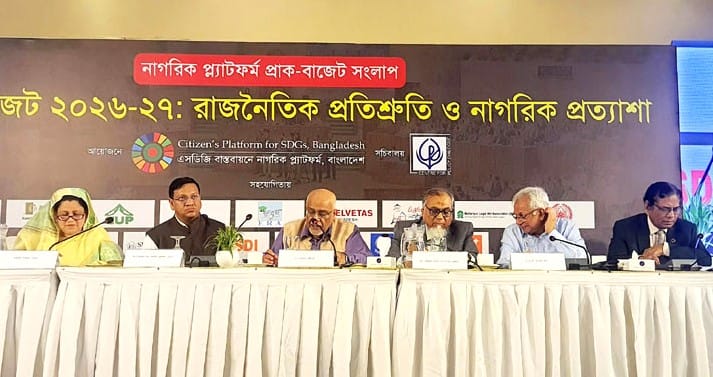
Economists, researchers and business leaders on Monday urged the government to prioritise governance, tax reforms and efficient public spending in the upcoming national budget for fiscal year 2026–27, warning that weak implementation and corruption could undermine its effectiveness.
They said a large budget alone would not deliver results unless matched by transparency, accountability and stronger execution capacity.
The observations came at a pre-budget dialogue titled “National Budget 2026–27: Political Commitments and Citizens’ Expectations”, organised by the Citizen’s Platform for SDGs, Bangladesh, at a hotel in Gulshan.
The session was moderated by Dr Debapriya Bhattacharya, convener of the platform and a distinguished fellow at the Centre for Policy Dialogue (CPD). Speakers included economists, academics, business leaders and political representatives.
Prof Mustafizur Rahman, a distinguished fellow at CPD, highlighted what he described as a “large gap” between taxes paid by citizens and actual revenue reaching the সরকারি treasury, attributing it to corruption and systemic inefficiencies.
He warned that the country’s economic foundation would remain weak unless this gap is addressed.
Despite significant investment in automation, the tax-to-GDP ratio has declined from 10.9 percent to 7.7 percent, he noted, citing lack of interoperability across government systems as a key constraint. He called for modernising the tax regime through cashless transactions and income-expenditure-based return systems.
Rahman also flagged rising risks from non-performing loans and mounting debt servicing costs. Allocating around Tk 1.4 lakh crore for interest payments alone in the budget, he said, is “highly risky,” urging policymakers to break the cycle of borrowing to repay interest.
He further cautioned that any move to allow zero-duty access for thousands of products under bilateral arrangements could create complications with other trading partners, stressing the need for forward-looking policy planning.
Business leader Fazlul Haque, former president of BKMEA and managing director of Plummy Fashions Ltd, said implementing a budget of nearly Tk 9 lakh crore in the current fragile economic situation would be a major challenge.
Persistent budget deficits, he noted, remain difficult to finance, making fiscal discipline, transparency and efficiency in public expenditure management more critical than ever.
He added that private investment is unlikely to rebound quickly without resolving the ongoing liquidity stress in the banking sector and persistent gas and power shortages. Addressing infrastructure bottlenecks, he said, should be an immediate priority.
Prof Sharmind Neelormi of Jahangirnagar University emphasised the role of local government institutions and elected representatives in ensuring effective utilisation of public funds at the grassroots level.
She criticised the National Board of Revenue (NBR) for frequent policy shifts that create uncertainty among taxpayers. Instead, she proposed expanding the tax net through awareness campaigns, including engaging university students to encourage voluntary tax compliance.
Neelormi also suggested tax exemptions on small inherited assets received by rural women, arguing for a more equitable tax structure.
On illicit financial flows, she said nearly 80 percent of money laundering occurs through under- and over-invoicing, calling for stronger institutional capacity to tackle the issue. She also urged a rethink of blanket privatisation policies, advocating improved efficiency in state-owned entities.
Dr AK Enamul Haque, director general of the Bangladesh Institute of Development Studies (BIDS), observed that key budget decisions are often finalised by March, limiting the impact of subsequent public discussions and parliamentary debate.
He said policymakers tend to focus more on revenue mobilisation than on expenditure efficiency, which undermines overall fiscal effectiveness.
Criticising what he termed a “feudal mindset” in project planning, Enamul Haque pointed to excessive land use in public projects in a land-scarce country, calling for more efficient, vertical development approaches.
He also described the current tax system as overly target-driven and disconnected from taxpayers’ actual capacity, likening it to an outdated extractive model.
A fundamental shift in tax policy, he said, is needed to align with economic realities in a globalised world.
Overall, speakers stressed that strengthening governance, improving institutional capacity and ensuring fiscal discipline would be crucial to making the upcoming budget credible, effective and responsive to citizens’ expectations.