


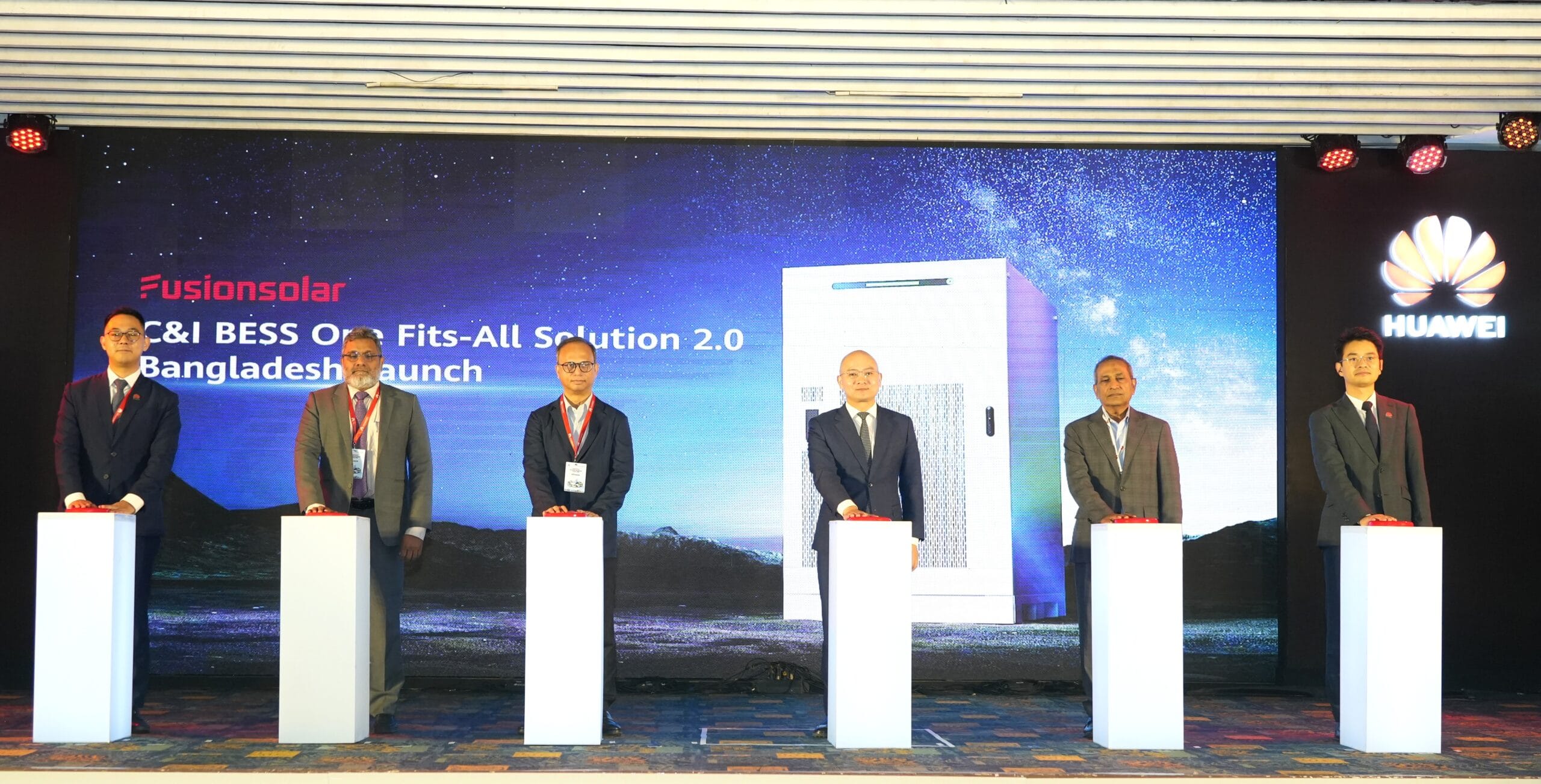
Chinese technology giant Huawei has introduced a new large-scale energy storage system on Thursday aimed at supporting Bangladesh’s growing industrial demand for reliable and sustainable power.
The system, known as the LUNA2000-241KWH-2S1, was unveiled at an event in Dhaka attended by industry leaders, factory owners and engineering firms. It is designed for the country’s commercial and industrial (C&I) sector, where rising energy costs and supply instability remain pressing concerns.
Company executives said the new Energy Storage System (ESS) offers high efficiency and enhanced safety features tailored to local market needs. The product forms part of Huawei’s broader push into renewable energy solutions across South Asia.
Jason Wu, President of Huawei South Asia Region and CEO of Huawei Bangladesh, said the country is at a “pinnacle of solar energy transition”, highlighting the role of digital power technologies in improving efficiency and reducing emissions.
According to Huawei, its solutions have already contributed to the generation of more than 430 million kWh of electricity in Bangladesh while cutting carbon emissions by over 200,000 tonnes.
Will Yu, Managing Director of Huawei South Asia Digital Power, said the new battery energy storage system (BESS) incorporates a dual-link safety architecture and hybrid cooling technology, achieving a reported round-trip efficiency of 91.3%.
He added that the system would help strengthen energy security and support industrial growth.
The LUNA2000 series also features a “pack optimiser” enabling full depth of discharge and an active balancing module designed to extend battery lifespan.
Automated operation and maintenance functions further improve system performance, Huawei said.
The launch event included discussions on the future of renewable energy in Bangladesh, with contributions from academics and industry specialists on challenges, emerging trends and geopolitical factors affecting the sector.