


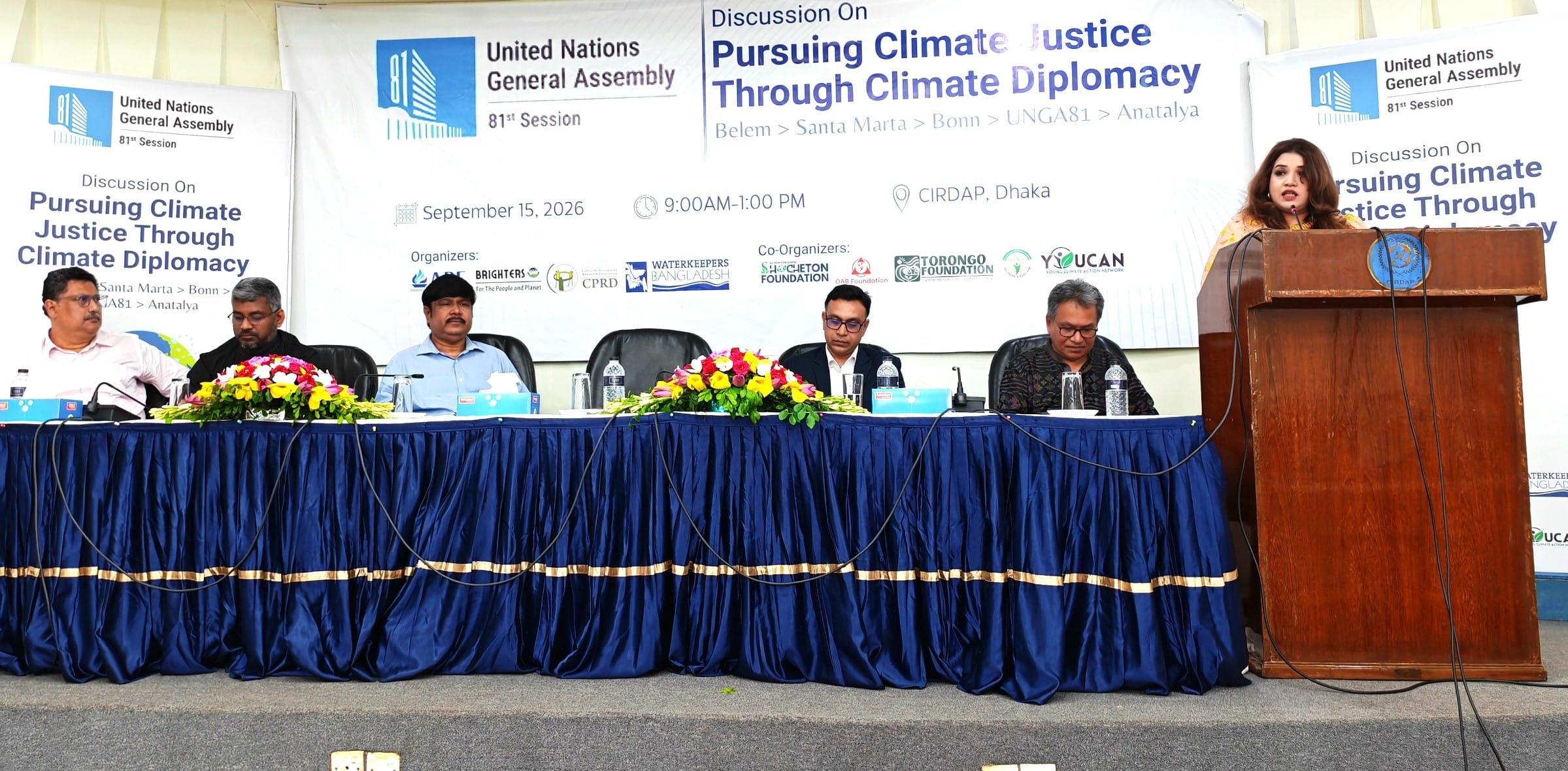
Bangladesh must adopt a stronger and more coordinated position on climate justice ahead of the 81st United Nations General Assembly and the COP31 climate summit, experts and civil society representatives have said.
At a discussion in Dhaka on Tuesday, speakers called for greater international action on climate finance, the Loss and Damage Fund and a just transition, while urging the government to ensure that Bangladesh is seen not simply as a recipient of climate assistance but as a strategic voice in global climate diplomacy.
State Minister for Foreign Affairs Shama Obaed Islam, who was chief guest at the event, said Bangladesh would focus on four priorities in its international engagement ahead of UNGA81 and COP31.
These include moving the Loss and Damage Fund and other climate finance commitments from pledges to implementation; securing predictable, accessible and grant-based finance without adding to developing countries’ debt burdens; ensuring a genuine just transition that protects workers and communities while making clean technologies affordable; and adopting gender-responsive climate policies that recognise the disproportionate effects of climate change on women and children.
Ms Obaed Islam said Bangladesh was also taking steps domestically rather than relying solely on international demands. The government plans to excavate and re-excavate 20,000 kilometres of rivers and canals and plant 250 million trees over the next five years, she said.
She added that the government aims to generate 20 per cent of the country’s energy from renewable sources by 2030, with the share rising to 30 per cent by 2040.
The state minister also said Bangladesh would establish a carbon credit market as part of its efforts to support climate action and emissions reduction.
She further highlighted the environmental pressure created by the presence of around 1.3 million Rohingya refugees, particularly in areas hosting large refugee populations, where the influx has placed additional strain on local ecosystems and natural resources.
Professor Mahmudul Hasan, a former professor at Patuakhali Science and Technology University and an international expert on climate and disaster management, said Bangladesh’s existing climate commitments needed to be properly monitored.
He also called for wider access to decarbonisation technologies, arguing that Bangladesh should not face pressure to adopt measures before viable alternatives are available. At the same time, he stressed the importance of keeping the country’s industries operational.
M Hafizul Islam Khan, a climate negotiator for the Least Developed Countries Group, said effective climate diplomacy could not be led by a single ministry.
He called for closer coordination between the Ministry of Foreign Affairs, which should lead diplomatic engagement, the Ministry of Environment on technical matters, and the Prime Minister’s Office.
Professor Dr Kamruzzaman Majumder, chairman of the Center for Atmospheric Pollution Studies, said Bangladesh needed to articulate its position clearly at the United Nations General Assembly and subsequently at COP31 in Antalya, Türkiye.
He urged stronger coordination between the foreign and environment ministries so that Bangladesh’s climate priorities could be presented more effectively internationally.
The discussion, titled “Pursuing Climate Justice Through Climate Diplomacy”, was held at the CIRDAP Auditorium in Dhaka.
Participants said closer cooperation was needed between government agencies, civil society, youth organisations and international partners. They argued that Bangladesh should present itself internationally as an active advocate for climate justice, rather than primarily as a country seeking financial assistance.
The event was jointly organised by Waterkeepers Bangladesh, the Association for Political Empowerment, Brighters and the Center for Participatory Research and Development. Shocheton Foundation, OAB Foundation, Torongo Foundation, Youth Environment and Development Organization and Young Climate Action Network also supported the event.