


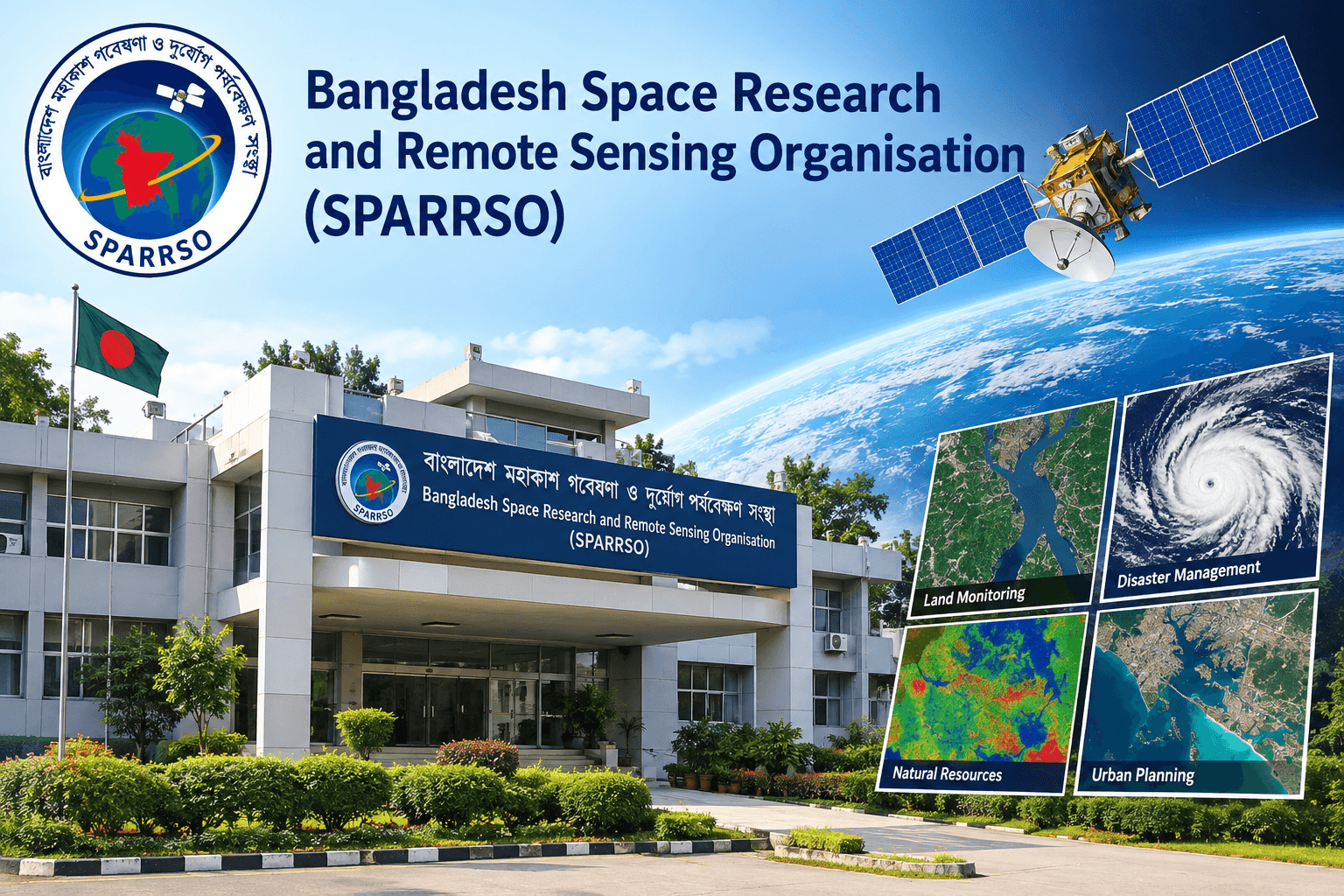
A Tk 68.62 crore project to strengthen the capacity of Bangladesh’s national space research organisation has achieved only 10% physical and 5.9% financial progress, with just six weeks remaining before its scheduled completion.
The slow progress comes less than two months after Prime Minister Tarique Rahman made an unannounced visit to the Bangladesh Space Research and Remote Sensing Organisation (SPARRSO) and directed officials to transform it into a modern, future-ready institution capable of supporting national development and security.
During his 28 June visit, the prime minister inspected different sections of SPARRSO, spoke with officials and staff, and was briefed on its research and ongoing projects. He stressed the need to strengthen the organisation’s capabilities in advanced space science, satellite technology and remote sensing.
However, an inspection by the government’s project-monitoring agency shortly afterwards found that key components of a major SPARRSO capacity-building project remain stalled, raising doubts over whether its objectives can be achieved within the approved timeframe.
The Implementation Monitoring and Evaluation Division (IMED), which inspected the project on 18 August, found that two critical consultants had yet to be appointed, procurement procedures had undergone repeated changes and the designated project director was scheduled to join only after the project’s official closing date.
IMED sent its inspection report to the Ministry of Defence on 13 September, concluding that the project’s objectives could not be achieved within the approved timeframe at the current pace.
The project, titled “SPARRSO’s Capacity Building”, is scheduled to end on 31 October, 2026, after running for three years since November 2023.
Critical consultants still not hired
Two of the project’s key consultancy assignments remain incomplete nearly three years after its launch.
SPARRSO has yet to appoint a space technology specialist to prepare a technical roadmap or a consultant to assist with the procurement of a Polar Orbiting Satellite Ground Station.
According to IMED, the original Development Project Proforma (DPP) provided for hiring both consultants through Single-Source Selection (SSS). The method was later changed to Quality and Cost Based Selection (QCBS), which involves competitive bidding.
The project director told inspectors that the change in procurement method had contributed to the delays.
IMED, however, questioned the original decision to use single-source selection, saying it restricts competition and makes it difficult to ensure value for money.
A proposal to revise the DPP, including changes to the consultant-selection method and project costs, was sent to the Planning Commission on 16 August and remains pending.
Project director to join after project ends
The inspection also raised concerns over the appointment of the project’s next director.
The designated officer is scheduled to join in mid-November, around two weeks after the project’s 31 October closing date.
Government rules require a project director to have at least six months of service remaining beyond a project’s completion date.
IMED advised the authorities to exercise greater caution in appointing project directors and comply with the relevant rules.
Procurement and duplication concerns
A Tk39 lakh tender for computers and accessories, floated in March, was cancelled following a government-wide suspension of procurement under the relevant budget code.
IMED also raised concerns over the inclusion of activities from another project, “Installation and Operation of an Optical Telescope System in Bangladesh under Asia Pacific Science Observations (APSSO)”, in the capacity-building project.
It recommended examining whether the overlapping activities could lead to duplication or unnecessary increases in project costs.
Only a few major procurement activities have been completed so far.
SPARRSO has procured satellite imagery worth Tk1.85 crore against an estimated Tk2 crore. Office furniture, seminar stationery and some computer accessories under a framework contract have also been purchased.
An outsourced manpower contract worth around Tk9.55 lakh, floated in December 2025, remains in effect and is scheduled to end in October.
Extension may be sought
The project implementation committee had already instructed officials at a 12 March meeting to accelerate implementation and pursue approval of the DPP revision.
The project steering committee followed up at its 11 June meeting, asking officials to press the Planning Commission for speedy approval.
The committee also discussed the possibility of extending the project by one year once the revision is approved.
Audits incomplete, sustainability plan sought
IMED found that statutory audits for fiscal years 2024-25 and 2025-26 had not yet been completed.
It also asked SPARRSO to prepare a formal plan for maintaining newly acquired equipment and sustaining the benefits of staff training after the project ends.
The organisation is expected to meet the operating and maintenance costs of the new ground station from its regular budget.
IMED further instructed the ministry and SPARRSO to update project information on the e-PMIS portal every month. The latest update had been made on 15 August.
Ground station at centre of project
The Tk68.62 crore project is fully government-funded and designed to strengthen SPARRSO’s satellite-image reception and analysis capabilities.
Its major components include establishing a new Polar Orbiting Satellite Ground Station and upgrading facilities linked to a Geo-Stationary Satellite Ground Station received from the Asia-Pacific Space Cooperation Organization (APSCO).
The project also includes the procurement of computing hardware and software and staff training.
SPARRSO operates under the Bangladesh Space Research and Remote Sensing Organisation Act, 1991. Its mandate includes applying space and remote-sensing technologies in agriculture, forestry, fisheries, geology, cartography, water resources, land use, meteorology, environment and oceanography.
IMED seeks urgent action
IMED made 11 recommendations, including preparing a strict, time-bound work plan with monthly progress reviews, urgently completing the recruitment of consultants and strengthening project monitoring.
The Ministry of Defence and SPARRSO have been given one month from the issuance of the report to inform IMED in writing about the measures taken to implement its recommendations.
##