


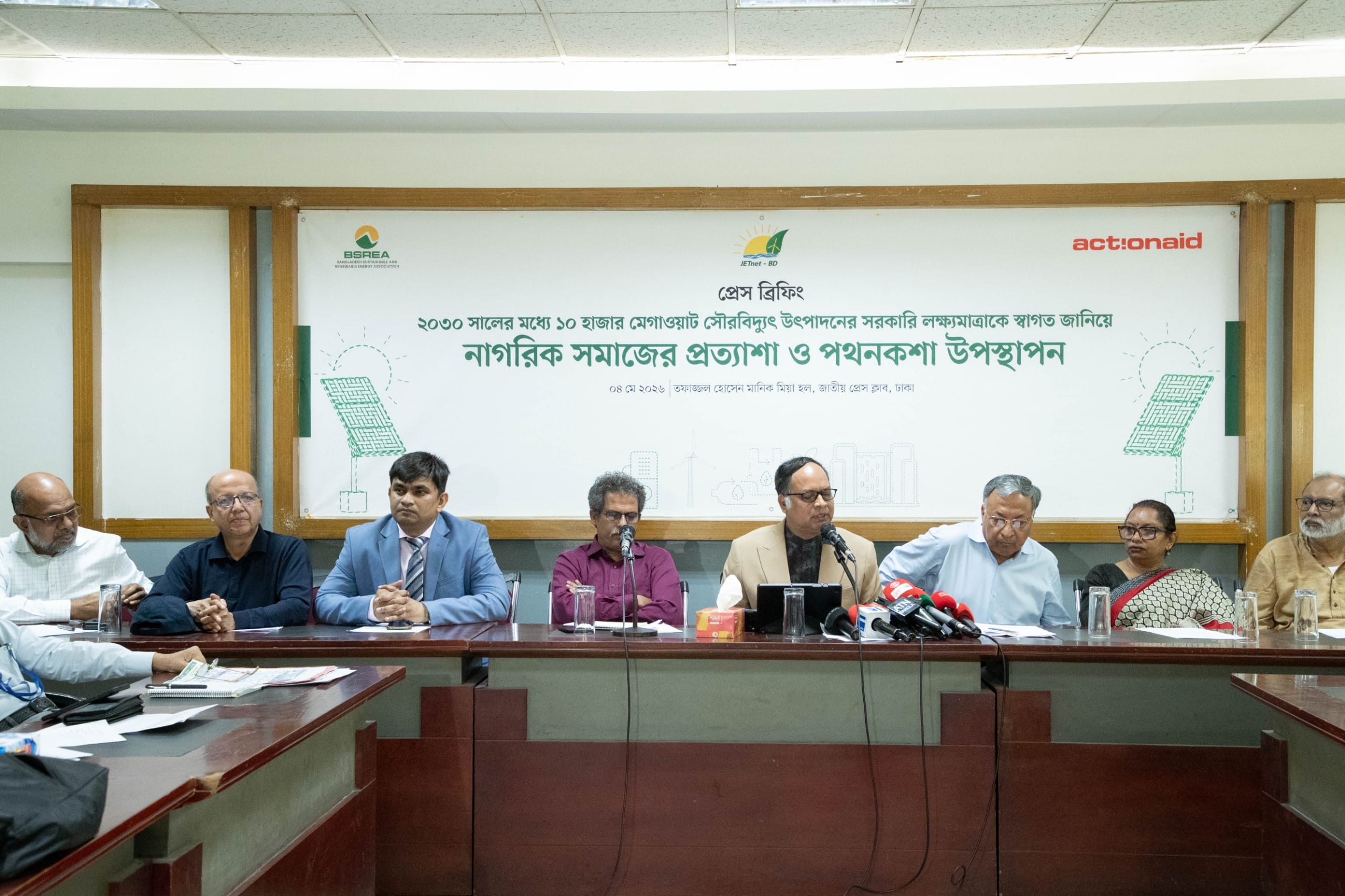
Civil society groups have welcomed the government’s plan to generate 10,000 megawatts of solar power by 2030, calling it a timely and strategic move toward energy security and long-term sustainability.
The reaction came at a press conference held on Monday at the National Press Club, jointly organised by ActionAid Bangladesh, the Just Energy Transition Network Bangladesh and the Bangladesh Sustainable and Renewable Energy Association.
Speakers said Bangladesh remains highly exposed to global energy shocks due to its dependence on imported fossil fuels. They pointed to ongoing geopolitical tensions, including the Russia-Ukraine War and instability in the Middle East, which have disrupted global supply chains and driven up energy costs.
Rising prices and supply constraints for oil, diesel and coal have already intensified load-shedding, affecting industries, agriculture and transport, they added.
In this context, the speakers stressed that accelerating the shift to renewable energy is the most viable long-term solution. Despite significant potential in solar, wind and biogas, Bangladesh has lagged in investment and policy support for the sector, they said.
They called for a clear and inclusive roadmap to implement the 10,000MW solar target, with stronger coordination among the government, private sector, experts and civil society.
Key proposals included reducing reliance on LNG imports, expanding investment in renewables, and offering tax incentives for rooftop solar, battery storage and electric vehicles.
They also urged increased financing through the Bangladesh Bank, including the creation of a dedicated revolving fund.
Other recommendations focused on scaling up solar irrigation, developing smart grid systems and decentralised power networks, and promoting renewable energy projects on public land under public-private partnership models.
Speakers highlighted the economic upside, noting that achieving the solar target could save $1.5 billion to $2 billion annually in fuel imports. Further savings could come from wider use of solar and electric technologies in irrigation and transport.
“This transition is not just about power generation—it is about energy sovereignty, economic resilience and climate security,” one speaker said.
The keynote was presented by energy analyst Shafiqul Alam and Change Initiative chief executive Zakir Hossain Khan. Representatives from various civil society organisations, energy experts and business leaders were also present.
Participants said they are ready to support the government in achieving the target, urging swift adoption of a realistic and actionable implementation plan.
They described the 10,000MW solar goal as a “historic opportunity” to strengthen Bangladesh’s energy security and advance a sustainable future.