


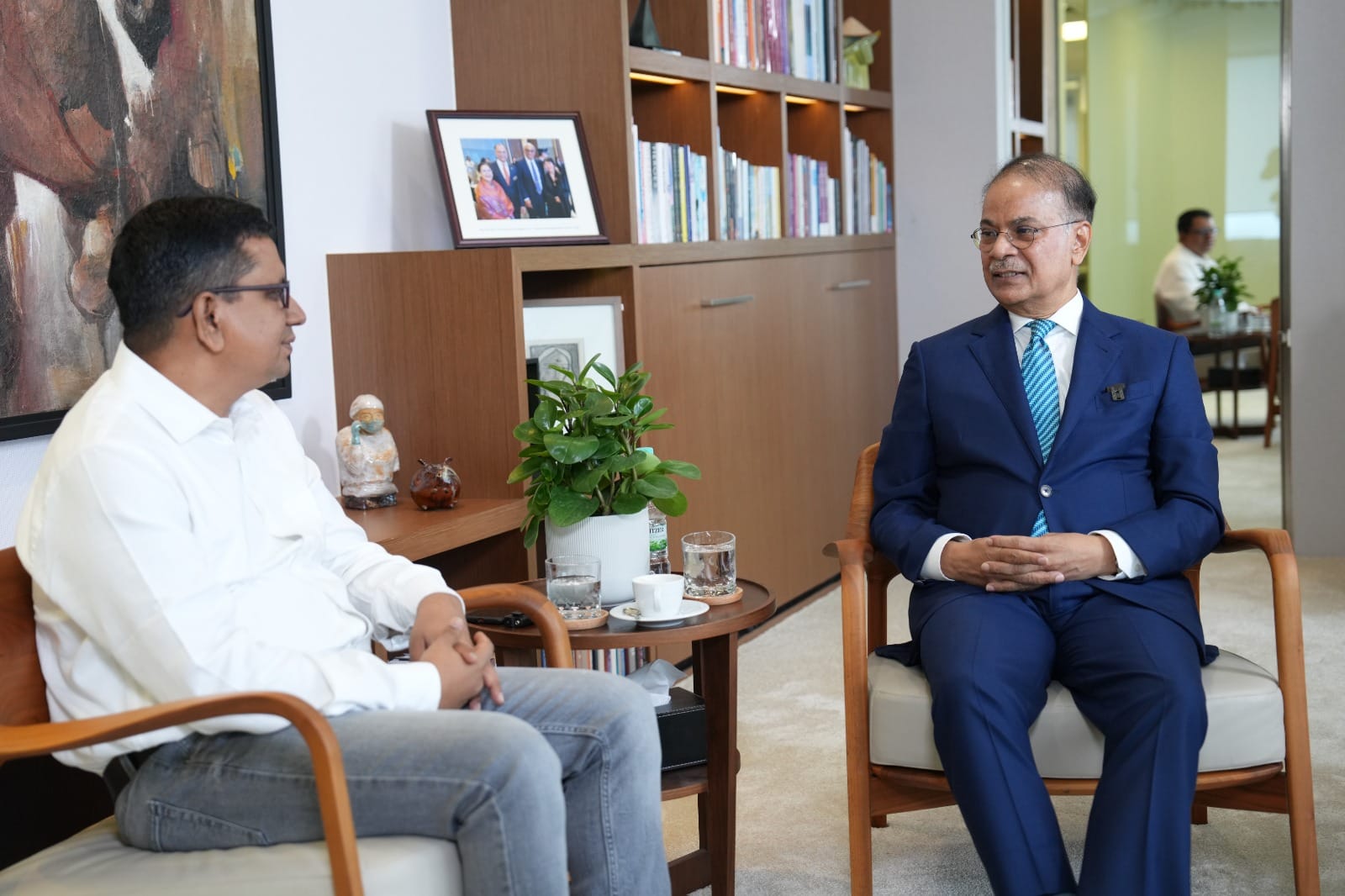
Confidence is unmistakable in both his gaze and demeanor, reflecting not only on what he has achieved, but also on what lies ahead.
I met him in Singapore on 26 March 2026, Bangladesh’s Independence Day, where he spoke candidly about policy uncertainty and what he described as a challenging investment climate back home.
Despite expressing disappointment over what he sees as persistent misunderstandings surrounding his legacy, he underscored his contributions to Bangladesh’s power, energy, ports, and data connectivity sectors over the past 52 years.
Undeterred, the Singapore-based business magnate is now looking ahead to fresh investments worth up to $3 billion in the coming years.
He is Muhammed Aziz Khan, Founder and Chairman of Summit Power International Ltd.
In an exclusive interview, Just Energy News Editor Md. Shamim Jahangir spoke with Aziz Khan at his Singapore office.
The wide-ranging conversation covered Bangladesh’s private power purchase agreement review, the future of investment, and the potential to transform surplus electricity into a driver of data infrastructure growth.
He also addressed allegations of money laundering linked to Singapore.
Md. Shamim Jahangir: Assalamu alaikum. On behalf of the Just Energy News, we welcome you. How do you evaluate the current investment climate in Bangladesh?
Muhammed Aziz Khan: The global investment climate is challenging due to ongoing crises. Bangladesh is no exception, and recent political transitions and regulatory uncertainties have added further complexity.
Interest rates are a key factor. While there were expectations of a rate cut, discussions are now shifting toward possible increases. In advanced economies like the United States, rates remain elevated.
If U.S. rates are around 4-5%, Bangladesh could face borrowing costs of 9% or more due to risk premiums. Since financing costs are central to investment decisions, this places Bangladesh in a difficult position.
Policy and Regulatory Challenges
Md. Shamim Jahangir: What policy issues are currently affecting investors?
Muhammed Aziz Khan: Bangladesh requires significant investment. Our company has already invested $3.5 billion and plans to invest an additional $3 billion.
However, investors need policy stability and regulatory clarity. Recent legal changes and attempts to revisit previously signed contracts have created uncertainty.
When contract sanctity is questioned, global financiers, including banks and multilateral lenders, lose confidence. This makes raising capital extremely difficult.
We are closely monitoring the situation and hope the elected government will resolve these issues and restore stability.
Political Transition and Investment
Md. Shamim Jahangir: Has the transition from an interim to an elected government affected investment sentiment?
Muhammed Aziz Khan: The interim government emerged from a political movement and acted within that context. The current government has a different mandate.
Looking ahead, Bangladesh must adopt future-oriented strategies. For instance, the country now has power overcapacity due to lower-than-expected demand after COVID-19 and the Russia-Ukraine war.
This surplus can be turned into opportunity. One option is developing data centres, converting electricity into digital exports and foreign exchange earnings.
Rather than relying solely on a single-buyer power model, Bangladesh can integrate into the global digital economy. This requires strategic thinking, especially amid geopolitical risks affecting energy supply chains, including routes such as the Strait of Hormuz.
Energy Security and Diversification
Md. Shamim Jahangir: Can Bangladesh reduce dependence on the Strait of Hormuz for energy imports?
Muhammed Aziz Khan: Energy security is fundamental to economic development. Bangladesh imports about 30% of its gas and all of its oil, so reliance on a single route or source is risky.
Diversification is essential. LNG can be sourced from the Middle East, Mozambique, the United States, and Australia. A diversified portfolio ensures resilience. If supply is disrupted in one region, alternatives remain available.
FSRU Project
Md. Shamim Jahangir: Regarding the third FSRU project, how quickly could it be completed if approved?
Muhammed Aziz Khan: This is a $550 million investment. We have already invested an additional $20 million and secured long-lead equipment.
The vessel was ready for conversion and preparatory work was underway. However, policy disruptions have delayed progress and affected investor confidence.
If approval is granted, we can complete the project faster than comparable developments.
Md. Shamim Jahangir: How long would it take?
Muhammed Aziz Khan: At least two years. Offshore conditions, including seasonal wave patterns, affect execution. The project also involves complex infrastructure, including a six-kilometer subsea pipeline.
Contracts and Investor Confidence
Md. Shamim Jahangir: How do you respond to calls for reviewing past power sector agreements?
Muhammed Aziz Khan: Transparency is important, and the government has every right to review policies.
However, reopening signed contracts undermines contractual sanctity. Without certainty, financing becomes unviable, which ultimately harms Bangladesh’s development prospects.
Capacity Charges Debate
Md. Shamim Jahangir: Many economists argue that capacity charges are a burden. What is your response?
Muhammed Aziz Khan: Capacity payments reflect financing realities. Bangladesh has a B-minus credit rating, meaning borrowing costs are high – often above 10%.
Investors must recover capital costs, interest expenses, and risks related to currency and politics.
Compared to global benchmarks, our costs are among the lowest, and tariffs remain competitive within Bangladesh’s merit order system.
Energy Strategy and Gas Use
Md. Shamim Jahangir: Are gas-based power plants still viable?
Muhammed Aziz Khan: Yes. Bangladesh continues to rely heavily on gas, which still accounts for around 70% of domestic energy production.
Gas is not only essential for power generation but also for fertilizer production, which is critical for food security.
While coal may appear cheaper in the short term, gas remains the most practical long-term option. Bangladesh should also continue exploring new domestic gas reserves.
Renewable Energy
Md. Shamim Jahangir: What is your view on renewable energy development?
Muhammed Aziz Khan: We once had a 500 MW wind project in partnership with Denmark, but the license was cancelled.
Renewable energy requires consistent and predictable policy support. Its future will depend on how the current government prioritizes the sector.
Reputation and Allegations
Md. Shamim Jahangir: How do you respond to allegations of financial misconduct?
Muhammed Aziz Khan: These are perceptions, not facts. I have invested billions of dollars in Bangladesh in visible and operational assets – power plants, ports, and fiber networks.
No bank has ever declared any default. After more than five decades of work, such allegations are deeply painful.
Future Investment Outlook
Md. Shamim Jahangir: What does the private sector expect from the government?
Muhammed Aziz Khan: We do not seek special treatment, only stable and transparent policies that support national development.
Greater attention should also be given to farmers, who remain central to the economy but are often overlooked.
If sound policies are in place, we will continue investing in Bangladesh.
Md. Shamim Jahangir: Thank you, Muhammed Aziz Khan, for your time. We hope Bangladesh’s power and energy sector continues to grow through strong public-private collaboration.