


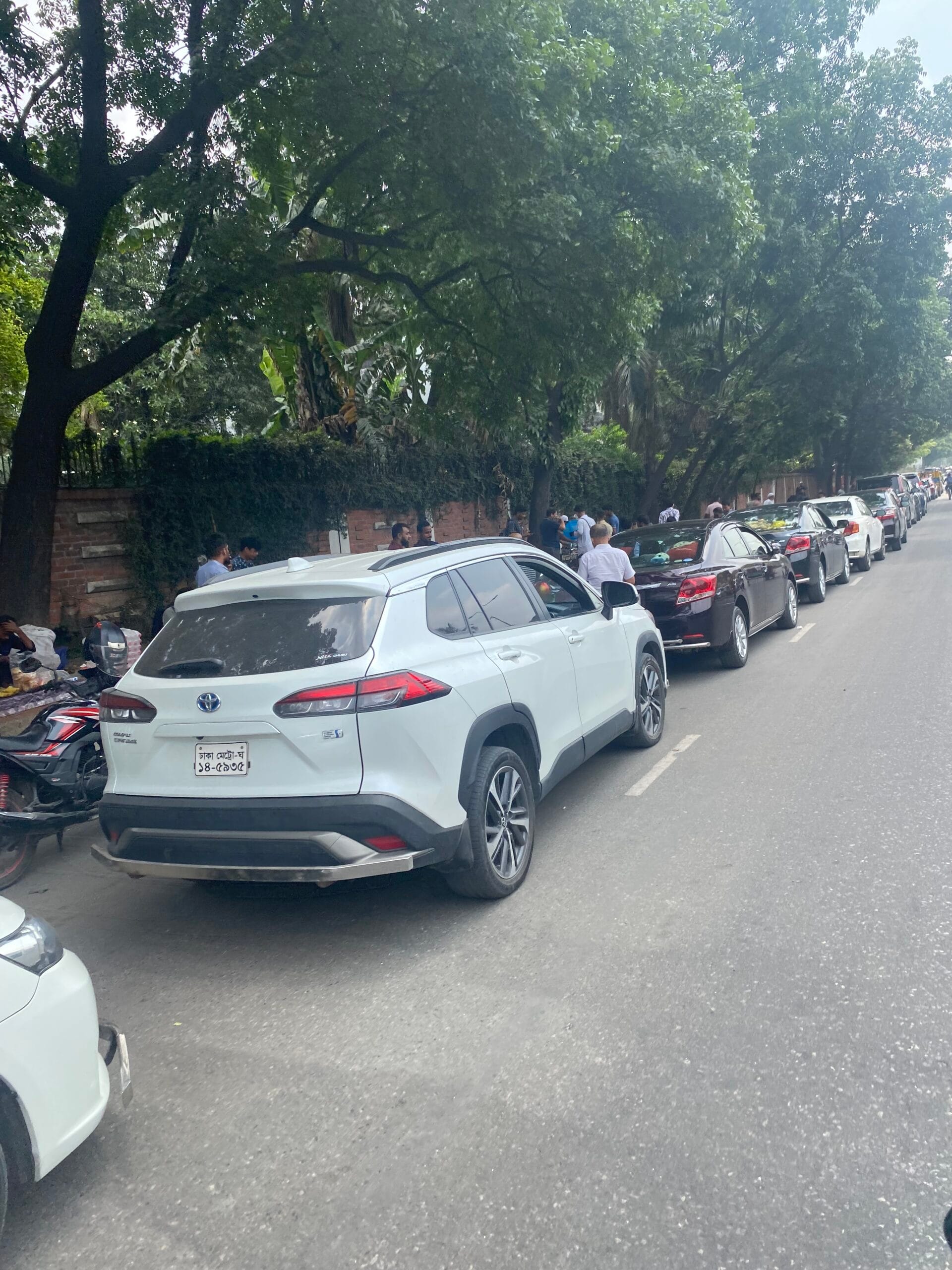
Dhaka is in the grip of a worsening transport crisis, not due to a shortage of vehicles, but because of where they are parked.
Long queues of private cars, microbuses, and trucks at fuel stations have turned major roads into de facto parking lots.
As the global energy crunch hits home, the rush for fuel has spiraled into widespread disorder, leaving commuters facing prolonged delays and daily hardship.
Gridlock: a city under strain
From early morning, fuel stations across Dhaka, from Tejgaon to Kalyanpur, become epicentres of severe congestion.
Vehicle “serials” often stretch far beyond station premises, forming double and even triple lines along both sides of the road.
These bottlenecks have reduced busy roads to narrow corridors, triggering secondary traffic jams across the city.
Commute times have surged dramatically, with trips that once took minutes now stretching into hours.
Emergency vehicles, including ambulances, are frequently trapped behind rows of idling cars, their sirens drowned out by constant honking.
Rule-breaking and black market activity
While the volume of vehicles is a major factor, widespread violations are worsening the crisis.
Influential motorists and local strongmen often bypass queues, creating informal “VIP lines” while others wait for hours or even half a day.
At the same time, organised exploitation is emerging, such as fuel hoarding and influence-based access.
In fuel hoarding practice, individuals repeatedly collect fuel in jars and bottles, stockpiling it for resale at higher prices on the black market.
On the other hand, some motorists use personal or political connections to secure large quantities of fuel in drums or containers, often with the tacit approval of station staff.
Titu Khan, a motorist, described how connections override the queue system. “I was advised to bring a large container instead of a motorcycle to avoid conflict in the line,” he said.
Digital system largely ignored
A government-mandated app introduced to regulate fuel distribution is largely ineffective on the ground.
Md Alamin, manager of Nukanjo Filling Station, acknowledged the lack of enforcement. “Most customers are not using the app, and we are not maintaining records either. Many people are collecting fuel multiple times a day,” he said.
Drivers confirm the absence of oversight. Rafiqul Islam, a microbus driver who waited since midnight, said no verification took place.
“No one checked the app or recorded my license plate, even after hours of waiting,” he said, adding that repeat collection is common.
Commuters and residents suffer
For those whose livelihoods depend on the road, the crisis is severe.
Ride-share driver Jubayer Khan said he often spends 8-12 hours in line just to refuel. “It’s unsustainable,” he said, suggesting stricter monitoring systems to limit repeat access within a fixed time or mileage range.
Uncertainty over supply compounds the frustration. Selina Akhter said she waited more than four hours only to be told the station had run out of fuel. “Idling in the queue consumed the little fuel I had left,” she said.
Truck driver Abdur Rahman alleged corruption at stations. “Staff prioritise those who pay extra or bring large containers, while genuine drivers suffer for hours,” he said.
Residents living near fuel stations are also affected. Sumon Ahmed pointed to the environmental toll.
“The noise and fumes from idling engines for hours are making us sick. If the app were enforced, these queues would shrink,” he said.
Proposed solutions
Experts suggest a three-pronged approach to restore order: mandatory digital logging, vehicle tracking integration, and ban on loose fuel sales.
They think strict enforcement of the government app through inspections and penalties for non-compliance are necessary .
For vehicle tracking integration, the expers believe linking fuel stations to a centralised database to monitor distribution by license plate and prevent repeat access within 24-48 hours.
The sale of fuel in jars, bottles, and drums at retail stations also needs to be prohibited, except for documented industrial use, to curb black-market activity.
A crisis of governance
While global fuel supply pressures persist, Dhaka’s situation reflects deeper failures in enforcement and accountability.
Weak regulation, rule-breaking, and informal practices have turned fuel distribution into a daily ordeal.
Unless authorities restore oversight and ensure compliance, the capital’s roads are likely to remain gridlocked, with commuters continuing to bear the burden.