


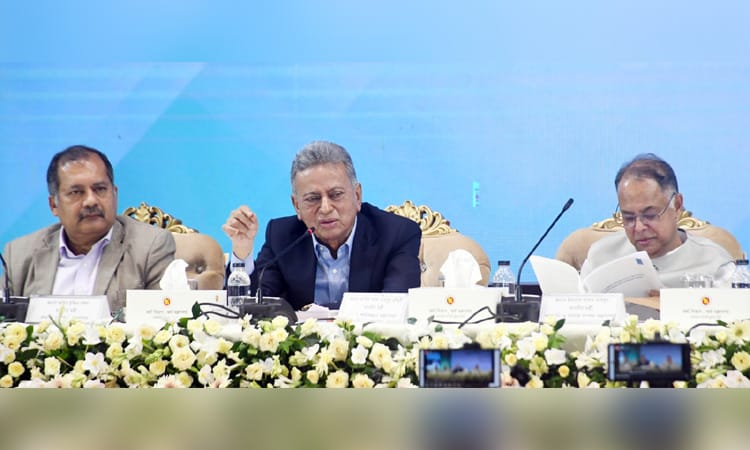
The government is gradually reducing its dependence on bank borrowing and reshaping fiscal management to create more space for private sector credit, Finance Minister Amir Khosru Mahmud Chowdhury said on Friday.
Speaking at a post-budget press conference at the Osmani Memorial Auditorium, the minister said the FY2026–27 budget reflects a shift in economic thinking in response to changing global realities.
“The global economy is changing rapidly. Our budgeting and public finance management must also change accordingly,” he said, adding that the government is moving away from traditional economic programming.
He said excessive government borrowing from domestic banks has long “crowded out” private investment by limiting credit availability for businesses.
“Banks should primarily finance the private sector. But government borrowing over the years has disturbed that balance,” he said.
Gradual reduction in bank borrowing
The finance minister said the new budget reduces government borrowing from local banks by around Tk 4,000–5,000 crore compared to the previous fiscal year.
The bank borrowing target for FY27 has been set at Tk 1.12 lakh crore, down from Tk 1.18 lakh crore.
“This is not a one-time correction. It is the beginning of a gradual shift,” he said, noting that the structure built over the past 15 years cannot be reversed overnight.
He expressed hope that continued reduction in government borrowing would free up liquidity for private investment, leading to higher production and job creation.
Shift towards market-based financing
Finance Secretary Dr Md Khairuzzaman Mozumder said the government is simultaneously expanding alternative financing sources to reduce pressure on the banking system.
He said public investment is being increased to 13 percent of GDP, up from the earlier 8–10 percent range, to stimulate economic activity and revenue growth.
He pointed to strong market response to the recent Tk 5,500 crore Sukuk issuance, which drew applications worth Tk 72,500 crore, as evidence of rising investor appetite for non-traditional instruments.
“This shows that the market is ready for diversified financing tools,” he said.
The government is also preparing to introduce green bonds, orange bonds and other instruments in both domestic and international markets, alongside efforts to deepen the capital market.
“Our objective is to move from a debt-heavy model towards equity- and market-based financing,” he added.
Inclusive budget vision
The minister described the Tk 9.38 lakh crore FY27 budget as an attempt to bring all citizens into the country’s economic planning framework.
“For the first time, we have tried to ensure that no group or community is left outside the budget process,” he said.
He said the budget was prepared under unusual time constraints following political transition, but consultations were held with multiple stakeholders to reflect public expectations.
“The true spirit of a budget is inclusion. We have tried to reflect that,” he said.
Reform framework and accountability
Khosru said the government has introduced four core criteria for evaluating public investment: value for money, return on investment, job creation, and environmental sustainability.
“These will guide how future projects are approved and implemented,” he said.
He acknowledged the challenges inherited by the administration, including fiscal strain, institutional weaknesses and global economic uncertainty driven by geopolitical tensions and rising protectionism.
“The global order is shifting, and uncertainty has become a constant factor in planning,” he observed.
Inflation to be tackled structurally
Responding to questions on inflation, the finance minister said price stability cannot be achieved through short-term enforcement drives.
“Inflation is not a three-month problem. It has been building for years,” he said.
He blamed rising costs on global fuel shocks as well as domestic inefficiencies in licensing, logistics and supply chains.
“From ports to permits, inefficiencies add cost at every stage, and the consumer ultimately pays the price,” he said.
The government, he added, will focus on deregulation, digitisation and long-term procurement planning to reduce structural costs in the economy.
The budget projects inflation at 7.5 percent for FY27.
Public sector pay and governance
The minister also defended the planned revision of government salaries, saying wages had remained unchanged for over a decade despite rising living costs.
He expressed hope that improved compensation would help reduce corruption, alongside stronger accountability systems.
“When people face financial pressure, distortions emerge. Better pay and better governance must go together,” he said.
Outlook
Khosru said the government’s overall aim is to build a balanced financial system where private sector-led growth is supported by a disciplined banking sector and diversified financing channels.
“The direction is clear: less pressure on banks, more space for the private sector, and a more inclusive and efficient economy,” he said.