


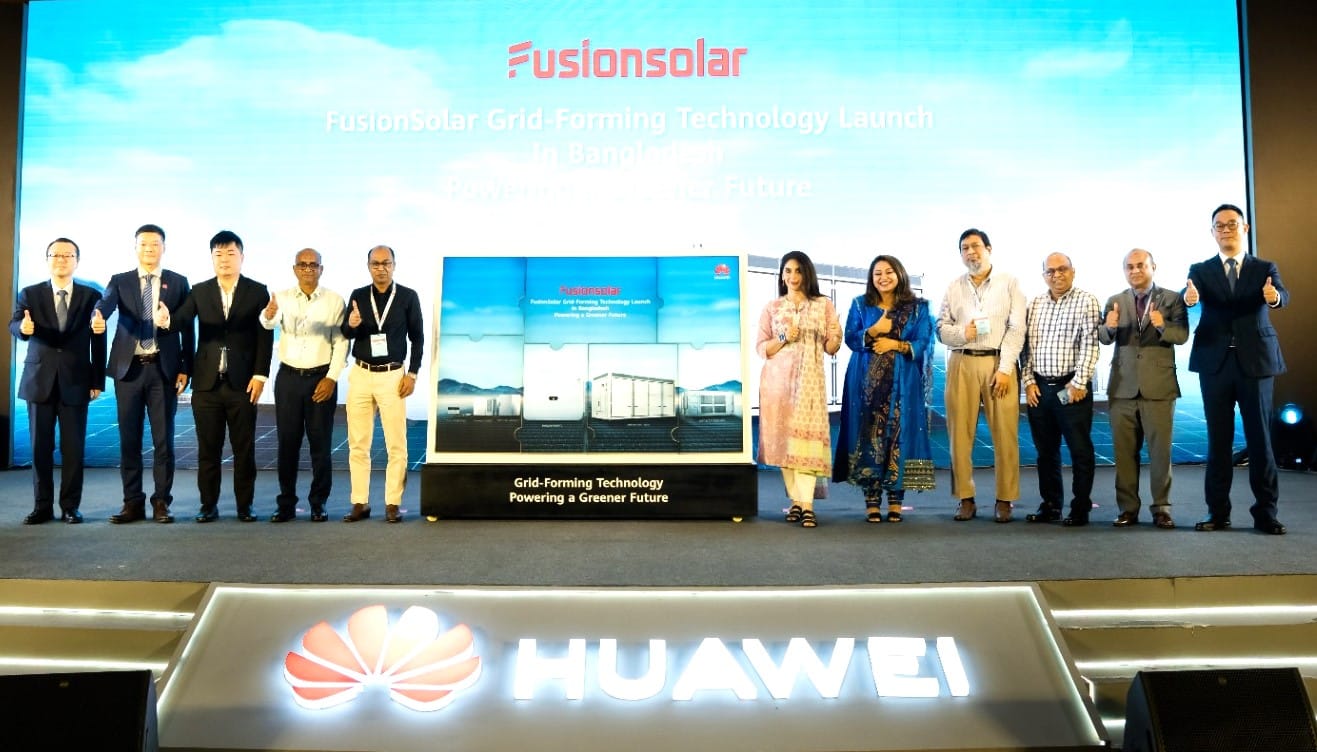
Huawei has launched what it describes as Bangladesh’s first utility-scale grid-forming smart string inverter and battery energy storage system, as the country seeks to expand renewable power generation and strengthen the resilience of its electricity network.
The Chinese technology group unveiled the systems at an event in Dhaka on Wednesday titled “Grid-Forming Technology Powering a Greener Future”, attended by officials and representatives from Bangladesh’s power and renewable energy sectors, including utilities, independent power producers, investors, consultants and engineering contractors.
Huawei introduced its SUN2000-506KTL-H3, which it describes as the first grid-forming smart string inverter with a capacity above 500kW, alongside the LUTERRA-6261-2S/4S battery energy storage system (BESS).
The company said the technologies are designed to support the integration of solar power into Bangladesh’s electricity grid by storing surplus daytime generation and releasing it when demand is higher.
Will Yu, managing director of Huawei South Asia’s Digital Power Department, said the combination of solar generation, battery storage and grid-forming technology would be increasingly important as countries moved towards cleaner electricity systems.
“Solar generation alone is no longer enough,” Mr Yu said. “We need intelligent energy storage and grid-forming technologies to ensure renewable energy is available whenever it is needed.”
The new inverter is designed to provide grid-forming functions alongside higher power density and improved operational and maintenance capabilities. Huawei said the system could help developers reduce balance-of-system costs and the levelised cost of energy.
The accompanying BESS has a claimed round-trip efficiency of 92.6 per cent and incorporates pack-level optimisation and a cell-to-grid safety architecture. Huawei also highlighted its state-of-health monitoring and rapid grid-forming response.
The technology is intended to provide functions including ramp-rate control, frequency and voltage regulation, and reactive power support. Huawei said these capabilities could improve the dispatchability of solar plants and help integrate greater amounts of renewable electricity into the national grid.
The company’s case for the technology was supported at the event by Masud Rana, head of technical at Paramount Group, which uses Huawei solar inverters at its 100MW Paramount solar plant.
Mr Rana said the plant’s locations in Lalmonirhat, Pabna, Sirajganj and Moulvibazar presented challenging operating conditions because of high levels of dust.
He said Huawei’s equipment was selected partly because of its IP66 protection rating, as well as what he described as a low inverter failure rate and responsive technical support.
Huawei’s announcement comes as Bangladesh looks to increase renewable energy generation while addressing the challenges of integrating intermittent sources such as solar power into its electricity system.
The company said its integrated Solar+Storage approach could help Bangladesh make greater use of renewable electricity while improving grid stability and resilience.
At the Dhaka event, Huawei executives also discussed global renewable-energy trends and the growing role of battery storage in the transition away from conventional power generation.