


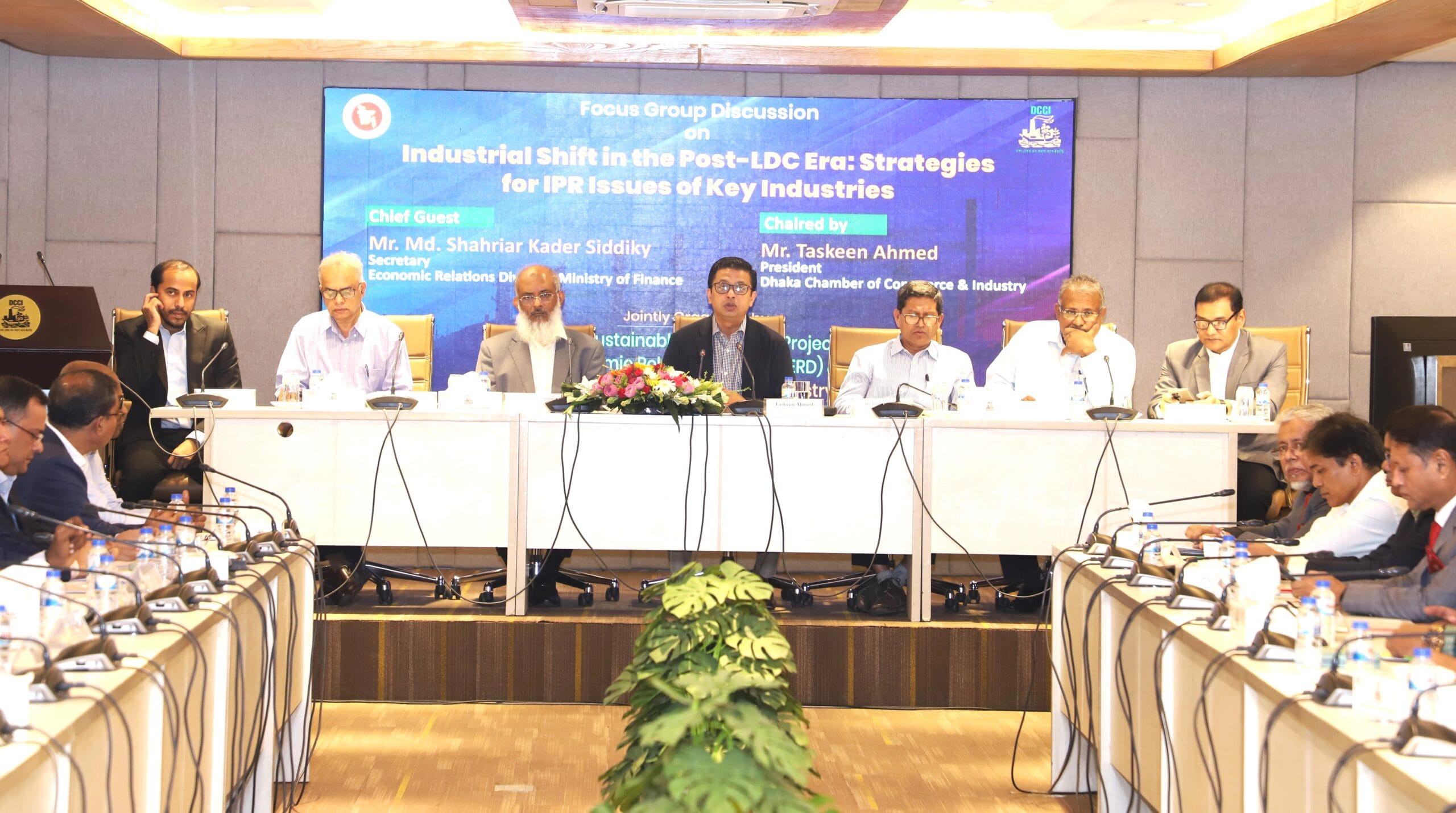
Bangladesh needs a stronger legal and institutional framework for intellectual property (IP) protection to help industries cope with the challenges of the post-LDC era, experts said at a DCCI discussion on Monday.
They stressed stronger enforcement of IP laws, faster dispute resolution, digitalisation of registration systems and greater coordination between government agencies and the private sector.
The speakers also called for increased investment in research and development, innovation, technology transfer and branding as Bangladesh prepares for tougher competition after graduation from the least developed country (LDC) category.
Speaking at the programme, DCCI President Taskin Ahmed said a strong intellectual property rights ecosystem would be essential for Bangladesh in the post-LDC period.
He said sectors such as pharmaceuticals and ready-made garments should focus not only on increasing production but also on innovation, branding, technology transfer and value addition.
Taskin identified delays in the existing IP legal framework, institutional coordination gaps, inadequate policies, limited institutional capacity and low private-sector awareness as major challenges.
He proposed establishing a modern and effective IP rights office, setting up IP tribunals in Dhaka and Chattogram for speedy settlement of disputes, introducing automated digital trademark registration, recruiting trained personnel and increasing awareness among small and medium enterprises.
AHM Jahangir, project director of the Skills for Sustainable Growth Project (SSGP) and additional secretary of the Economic Relations Division, said the private sector would face some of the biggest challenges following LDC graduation.
He stressed the need for proper enforcement of IP laws, industrial preparedness and appropriate policy measures.
ERD Secretary also said the government was working through the SSGP project to provide sector-specific technical assistance. Necessary amendments and reforms to relevant policies would also be undertaken, he said.
He added that the government had taken initiatives to bring all government services under digital operations, which are expected to be launched soon.
Presenting the keynote paper, Mohammad Ataul Karim, Faculty of Law, University of Oxford and former consultant at the WIPO Academy, said Bangladesh’s industries would need to make strategic use of IP rights in the post-LDC era.
He said TRIPS and possible TRIPS-plus obligations could pose new challenges for pharmaceuticals, software and IT, agriculture and industrial design, while also creating opportunities for innovation and technological and industrial transformation.
Bangladesh should make effective use of existing legal flexibilities on IP while increasing R&D investment, strengthening industry-academia collaboration and providing greater incentives for innovation, he said.
Md Jahangir Hossain, director general of the Department of Patents, Designs and Trademarks, said individual industrial sectors should prepare their own action plans to address post-LDC challenges, with appropriate support from government agencies.
Abdul Baki, project adviser of SSGP and former secretary, called for stronger coordination among government agencies and closer cooperation with the private sector during the extended LDC graduation timeframe.
Major General Dr Md Shahidul Islam (retd), secretary general of BGMEA, said effective enforcement of domestic IP laws and incentives for entrepreneurs would be crucial. He said BGMEA had established a Centre of Excellence to work on new product designs and IP issues in the RMG sector.
Raisul Kabir, founder and CEO of Brain Station 23, said Bangladesh could not rely on outsourcing alone and needed to prioritise new technology and innovation. He also called for stronger industry-academia collaboration and better IP protection in the IT sector.
Fayez Ahmed of Incepta Pharmaceuticals warned that applying international IP rules to Bangladesh’s pharmaceutical market could significantly increase medicine prices, while stressing that technological capacity must also be strengthened.
Kazi Mostafizur Rahman of the Bangladesh Agro-Chemical Manufacturers Association called for the agro-chemical sector to be treated as a priority sector with updated policies.
Dr Abureza M Mujareba of Dhaka University stressed stronger public-private cooperation in developing and commercialising new products and technologies, alongside greater attention to geographical indications (GI).
The discussion was also addressed by officials from the Copyright Office, Ministry of Commerce and Intellectual Property Association of Bangladesh, among others.