


The story of Bangladesh’s clean energy journey did not begin with solar panels or wind turbines. It began in the early 1960s with the establishment of the Kaptai Hydroelectric Power Station, marking a milestone in the nation’s energy infrastructure.
However, behind this achievement lies a legacy of displacement, loss, and enduring tension in the Chittagong Hill Tracts. The creation of Kaptai Lake, a reservoir for the power station, submerged vast tracts of land, displacing thousands of indigenous people. Many lost their ancestral homes, farmlands, and cultural sites with little to no rehabilitation or compensation. Communities reliant on Jhum cultivation faced a severe crisis, leading to food insecurity and unemployment.
Globally, the energy transition is being driven by the twin imperatives of sustainable development and climate change mitigation. Put simply, energy transition refers to the systemic shift from a fossil fuel-based energy system to a low-carbon energy system. In keeping with global trends, Bangladesh is also part of this transition, moving towards cleaner and more sustainable alternatives such as renewable energy, together with the use of more efficient and advanced technologies. However, this transition is not merely a technical shift; rather, it is a complex socio-economic transformation that will reshape industries, livelihoods, and communities.
The experience of Kaptai illustrates this complexity. While the project feeds 230 megawatts of electricity into the national grid, displaced communities did not gain access to the electricity or development benefits, even though a just transition entails ensuring that those who bear the costs also share in the benefits.
The concept of a just energy transition, rooted in labour movements and later embraced by global institutions, emphasises that the shift to a low-carbon energy system must be fair and inclusive. It calls for protecting workers, supporting vulnerable communities, and ensuring that the burdens and opportunities of transition are equitably shared.
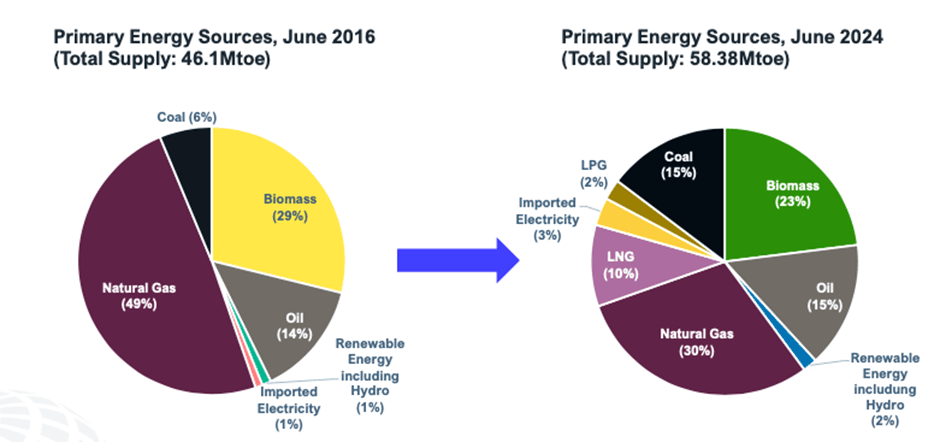
Fig. Transformation of Bangladesh’s Energy Sector (Source: IEEFA, 2025)
Bangladesh’s current energy landscape underscores why this approach is essential. Rapid population growth, rising incomes, and changing consumption patterns are driving a steady increase in energy demand. Yet the sector remains overwhelmingly dependent on fossil fuels, while renewable energy – excluding traditional biomass – accounts for only a small share of the energy mix. Although installed renewable capacity currently stands at 1,738 megawatts (SREDA, 2026), this represents only modest progress relative to national needs and climate commitments.
A transition away from fossil fuels will inevitably disrupt existing economic structures. Jobs linked to coal, oil, and gas will decline, affecting thousands of workers directly and indirectly. Without pragmatic planning, such disruptions could create new forms of economic vulnerability and social discontent.
At the same time, renewable energy sectors – particularly solar and wind – offer significant opportunities for green job creation, innovation, and local enterprise development. Realising this potential, however, requires deliberate investment in skills development, retraining programmes, and institutional readiness. A just transition demands well-coordinated policies that anticipate and manage social impacts. This includes reskilling workers displaced from fossil fuel industries, ensuring effective rehabilitation for communities affected by energy projects, and creating mechanisms for local benefit-sharing.
International experience offers valuable lessons. In several countries, energy transition efforts have encountered resistance in regions heavily dependent on fossil fuels, highlighting the importance of social dialogue, stakeholder engagement, and long-term planning.
For Bangladesh, where fiscal space is constrained and development challenges remain pressing, the stakes are even higher. Policymakers must navigate competing priorities while maintaining public trust and social cohesion.
Renewable energy can be a powerful driver of a more sustainable and resilient future for Bangladesh. It offers opportunities to reduce emissions, enhance energy security, and foster green growth. However, sustainability cannot be understood in environmental terms alone. It must also encompass social equity and economic inclusion.
The lesson from Kaptai is clear: progress that comes at the cost of people’s livelihoods, rights, and dignity is neither just nor enduring. As Bangladesh moves forward with its energy transition, embedding justice at its core will be essential, not only to avoid repeating past mistakes, but also to ensure that the benefits of change are shared widely across society.
A just energy transition is not simply an ethical imperative; it is a practical necessity. Without it, the path to a low-carbon future risks becoming socially divisive and politically fragile. With it, Bangladesh has the opportunity to build an energy system that is not only cleaner, but also fairer and more inclusive.
(Mohammad Alauddin is a former Rector of the Bangladesh Power Management Institute. He writes articles for Just Energy News, and can be reached at [email protected])