


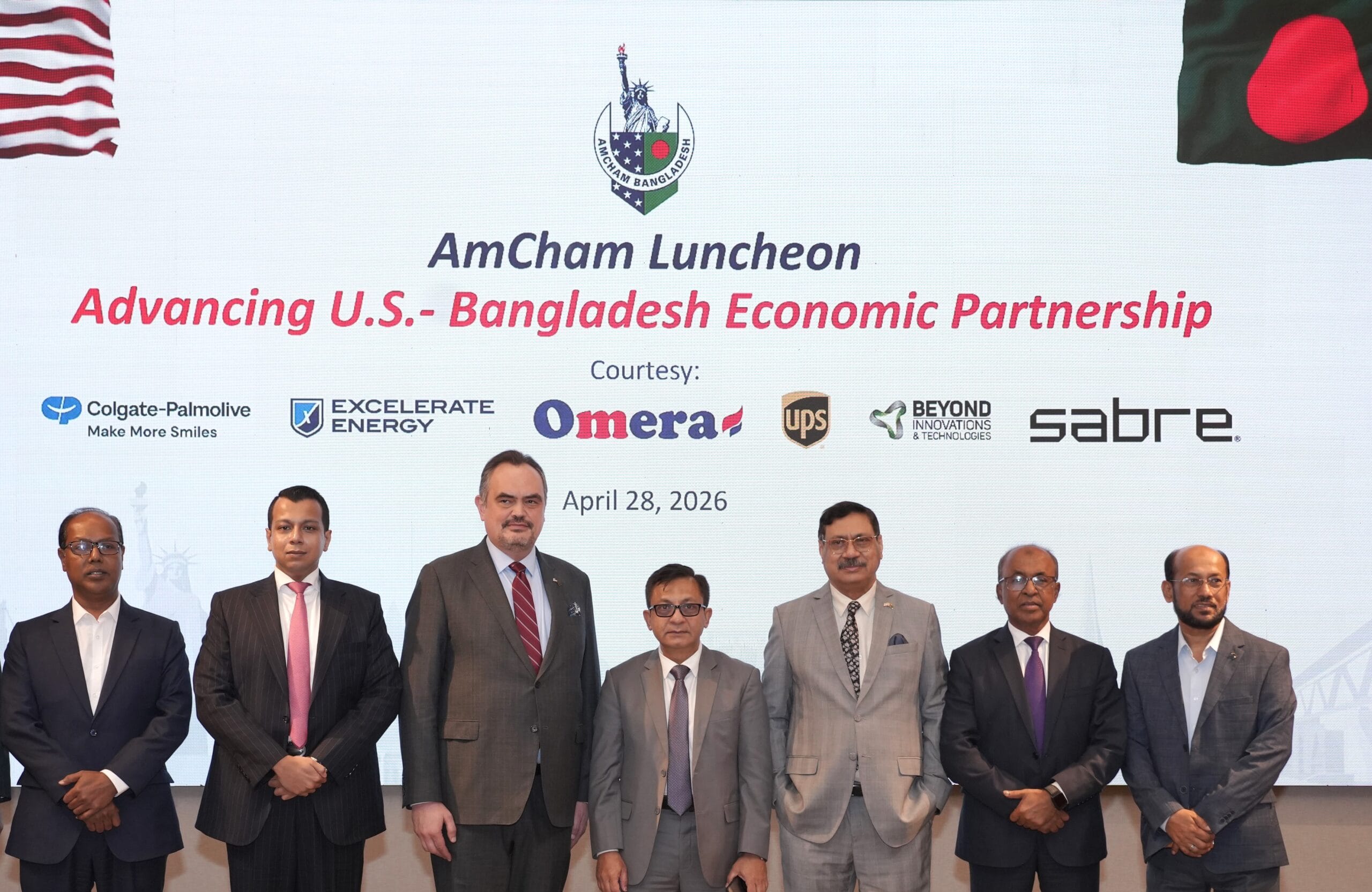
The United States ambassador to Bangladesh has signalled a shift towards a more investment-driven economic partnership, as senior policymakers and business leaders gathered in Dhaka to discuss deepening bilateral ties.
Speaking at a high-level luncheon hosted by the American Chamber of Commerce in Bangladesh at the Sheraton Hotel Dhaka on Tuesday, Brent T. Christensen said Washington is seeking to move beyond traditional aid frameworks in favour of trade and private-sector investment.
“Under President Donald Trump’s leadership, we’re moving away from policies that tolerated distorted trading relationships… toward a model that delivers benefits for both our people,” the ambassador said, describing a strategy centred on “trade over aid, investment over assistance”.
Tariffs, trade balance and ART framework
A key focus of Christensen’s remarks was the proposed Agreement on Reciprocal Trade (ART), which he described as a “transformative framework” for bilateral commerce. Under the arrangement, Bangladesh would retain access to the US market at a reduced tariff rate of 19%, compared with 35% otherwise.
In return, Dhaka is expected to ease non-tariff barriers and increase imports of US goods, particularly agricultural products. The ambassador noted a Bangladeshi commitment to purchase $3.5bn worth of US commodities, including wheat, soybeans, cotton and corn.
Call for reforms to attract investment
Despite praising Bangladesh’s economic trajectory, Christensen highlighted structural challenges that could deter foreign investors. He stressed the need for stronger contract enforcement, regulatory transparency and predictable policymaking.
“Trust requires that contracts be honoured,” he said, calling for reduced bureaucracy, fair licensing systems and lower tax burdens. He also pointed to the importance of intellectual property protection, labour standards and environmental compliance.
The ambassador further urged modernisation of customs systems and greater digitalisation, noting that Bangladesh’s largely cash-based economy presents opportunities for firms such as Visa and Mastercard, alongside growing interest from US technology companies.
Bangladeshi priorities and LDC transition
The event’s chief guest, Commerce Minister Khandakar Abdul Muktadir, emphasised export diversification and increased investment flows as central to Dhaka’s economic strategy. He identified pharmaceuticals, leather goods, agriculture, light engineering and ICT as priority sectors.
Muktadir also sought continued US support as Bangladesh prepares to graduate from least developed country (LDC) status, with a proposed transition timeline extending to 2029.
Broad participation from business and government
The luncheon, chaired by AmCham president Syed Ershad Ahmed, brought together senior government officials, diplomats, regulators and leading business figures. An interactive session allowed participants to raise concerns and explore opportunities directly with both the minister and the US envoy.
Christensen concluded by reaffirming Washington’s commitment to expanding economic engagement, describing the US–Bangladesh relationship as entering “a new phase” focused on shared prosperity.