


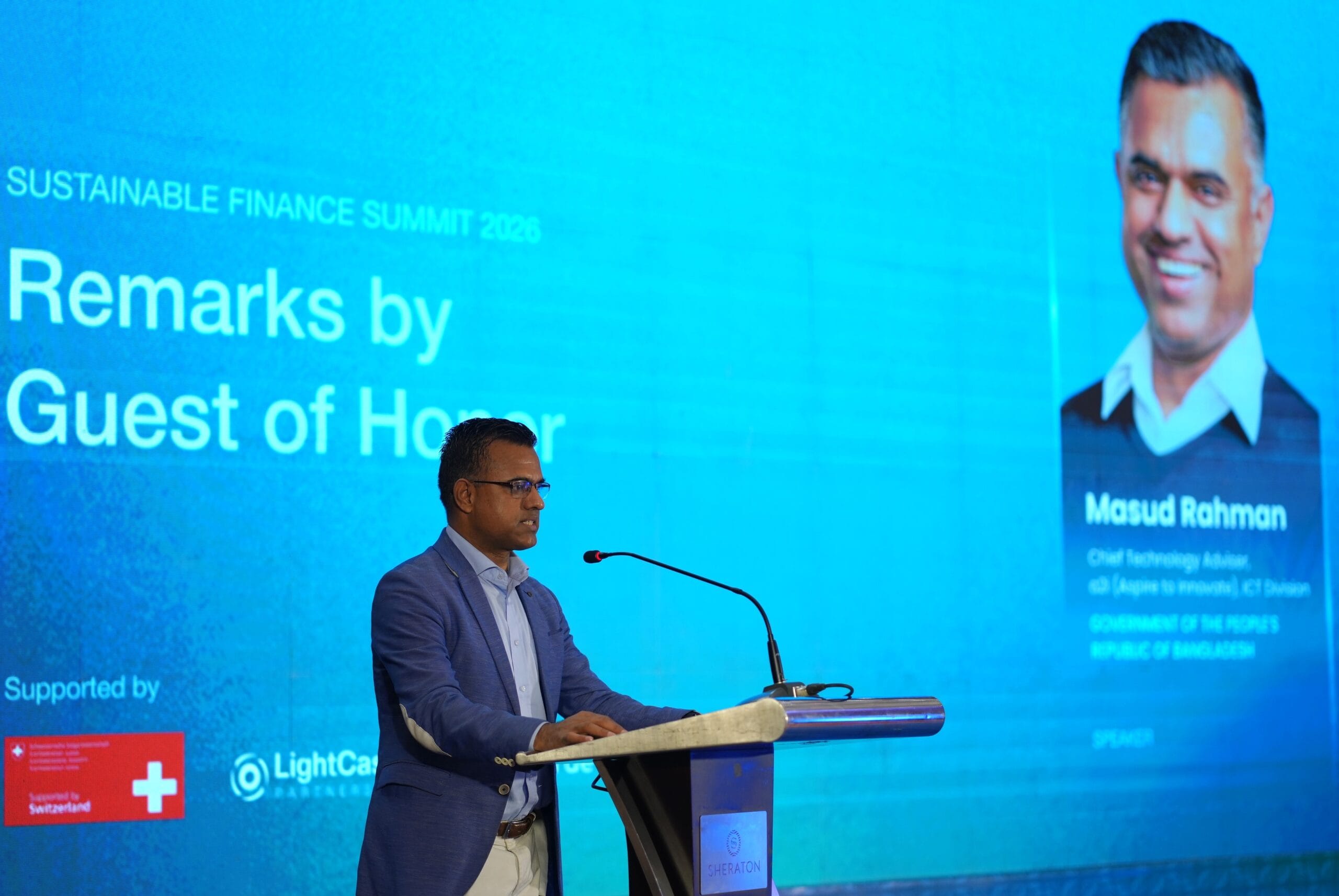
Bangladesh is seeking to accelerate the growth of sustainable and blended finance to strengthen climate resilience, support entrepreneurs and expand development initiatives, speakers said at the “Sustainable Finance Summit 2026” held in Dhaka on Thursday.
Organisers said the global sustainable finance market reached an estimated US$919 billion in 2025 and is projected to rise to US$1.1 trillion in 2026, while Bangladesh is also witnessing growing momentum in the sector.
According to figures presented at the summit, sustainable financing in Bangladesh totalled Tk 83.75 billion during the October–December quarter of 2025, representing 35.87 per cent of total disbursed loans.
The day-long summit, hosted by LightCastle Partners with support from the Embassy of Switzerland in Bangladesh, United Nations Capital Development Fund, Truvalu Bangladesh and Startup Bangladesh Limited, brought together policymakers, financiers, entrepreneurs and development stakeholders.
The event focused on mobilising blended finance and expanding Bangladesh’s sustainable finance market amid rising climate-related risks and growing demand for inclusive economic growth.
Opening the summit, Reto Renggli, Ambassador of Switzerland to Bangladesh, said sustainable finance had become central to future economic planning.
“Sustainable finance is no longer a niche agenda. It is essential for building an inclusive and future-ready economic foundation,” he said.
He also praised Bangladesh’s progress in climate resilience and financial inclusion, expressing hope that the summit would help unlock new investment opportunities and partnerships.
Among the keynote speakers was Masud Rahman, Chief Technology Advisor of the Aspire to Innovate (a2i) programme under Ministry of Information and Communication Technology, who said innovation, technology and sustainable financing must advance together to support long-term economic transformation.
The keynote presentation, delivered by Bijon Islam, examined how Bangladesh could move “from pledges to projects” by building an integrated investment ecosystem capable of attracting private capital.
He said the next phase of sustainable finance in Bangladesh would depend on creating a strong pipeline of investment-ready projects, implementing structural reforms and strengthening public-private partnerships.
The summit featured three panel discussions covering impact investing, blended finance, environmental, social and governance (ESG) financing, and the future of corporate responsibility in Bangladesh.
Speakers included Nuzhat Anwar, Nurul Hai, Kerry Breen, Nazat Chowdhury and Nabila Nowrin.
A presentation on Bangladesh’s evolving corporate sustainability landscape highlighted how corporate social responsibility is increasingly being used as a strategic tool for inclusive and sustainable growth rather than traditional philanthropic activities.
One of the summit’s major announcements was the launch of two investment initiatives — the “ORE-2 Fund” and the “Bangladesh Impact Fund” — unveiled jointly by Bijon Islam and Sharawwat Islam.
The funds aim to improve access to capital for small and growing businesses across Bangladesh, particularly enterprises with strong social and environmental impact potential.
More than 200 participants attended the summit, including representatives from government agencies, financial institutions, startups and international development organisations.