


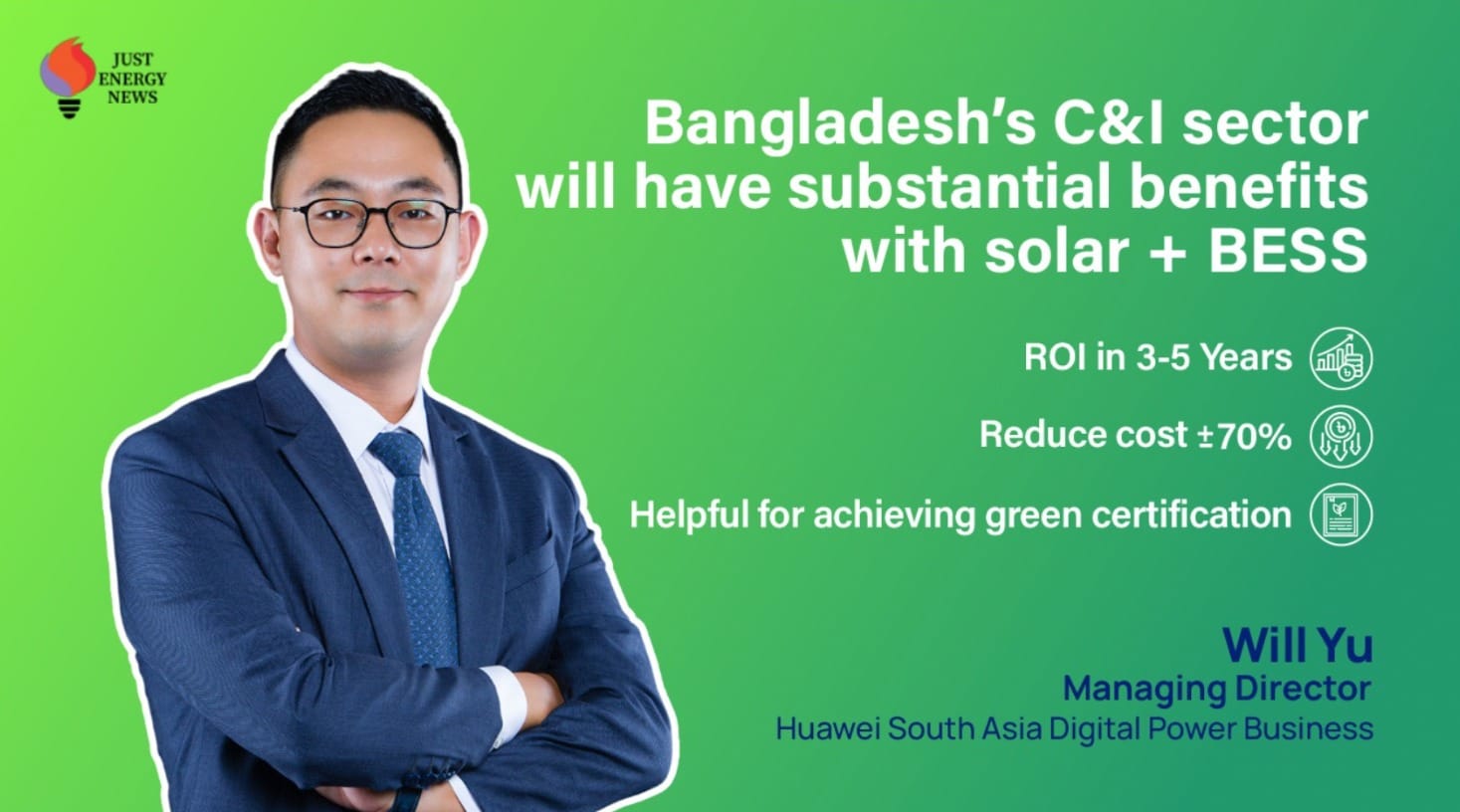
Will Yu, managing director of the South Asia Digital Power Business Group at Huawei, speaks to Just Energy News Editor Md Shamim Jahangir about Bangladesh’s renewable energy ambitions, energy storage systems (ESS), industrial decarbonisation, grid stability and electric vehicle infrastructure.
Will Yu graduated from Dalian Maritime University in 2012 with a Bachelor of Science in Electronic Information Engineering. Since November 2025, he has served as Managing Director of Huawei South Asia’s Digital Power Business Group. He previously held leadership positions at Huawei Philippines and the Huawei Nanjing Representative Office.
In this interview, he discusses why Bangladesh is well-positioned for large-scale solar and ESS deployment, how the garment industry can benefit from battery storage, and why safety and sustainability remain central to Huawei’s strategy.Just Energy News (JEN): Do you see Energy Storage Systems (ESS) as suitable for Bangladesh?
Will Yu: I believe renewable energy, including solar and ESS, is highly suitable for Bangladesh. The government has set ambitious targets of 20% renewable energy by 2030 and 30% by 2040, along with plans to install around 20 GW of solar capacity. These goals are logical, as Bangladesh can reduce its dependence on imported coal and oil and rely more on solar energy, which is freely available.
In this transition, ESS will play a crucial role by ensuring stable and continuous power supply during cloudy weather or at night. Huawei has conducted extensive research on “grid-forming” technology. Traditionally, the industry relied on “grid-following” systems, which cannot actively support the power grid. Grid-forming technology, however, provides voltage, frequency and phase-angle support.
When Huawei entered the digital power and solar business about a decade ago, we anticipated that renewable energy would become a major power source. Since then, we have focused on ensuring solar and wind can reliably support national grids and industrial applications.
For industries, ESS offers significant advantages. During factory load-shedding, diesel generators typically take five to ten seconds to restore power. In that short period, operations stop and lights go out. With grid-forming ESS, power can be restored within 20 milliseconds, making interruptions virtually unnoticeable.
ESS also ensures high-quality electricity by stabilising voltage, frequency and harmonics — which is especially important for industries such as textiles and pharmaceuticals. Diesel power cannot consistently provide this level of quality and may eventually damage machinery.
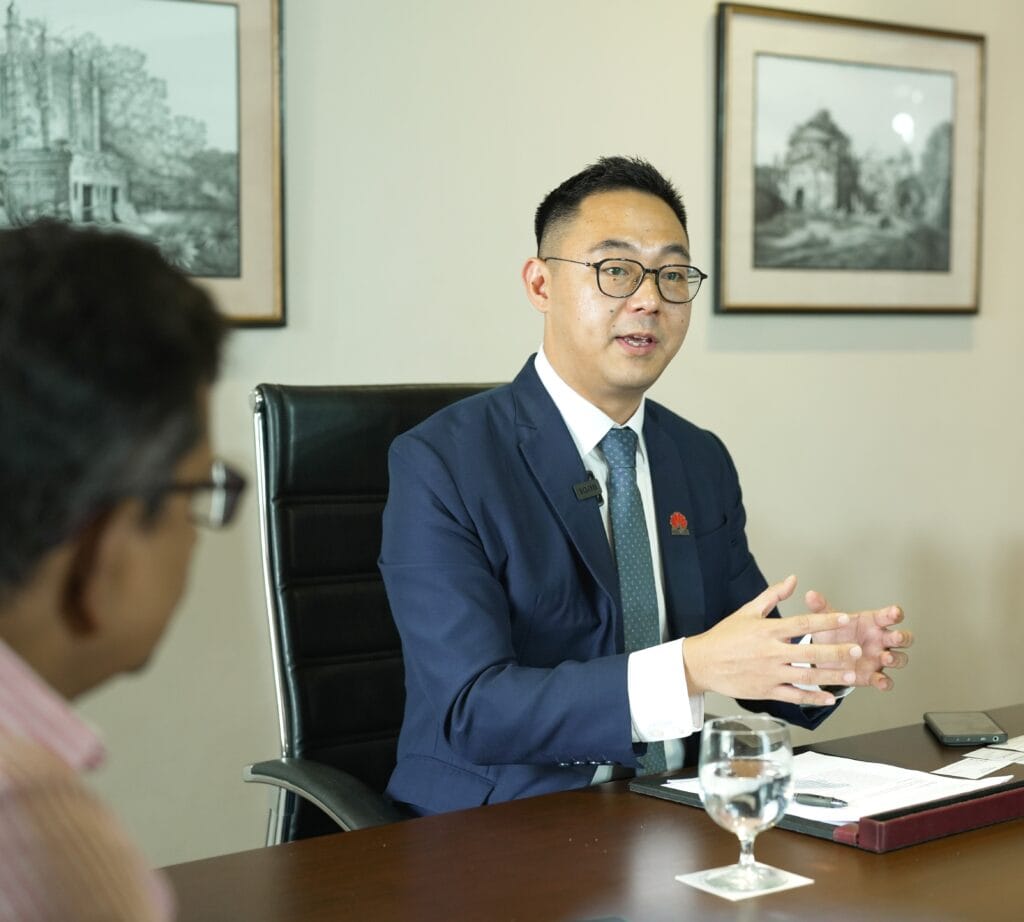
JEN: RMG factories often lack rooftop space and still rely heavily on diesel generators. Given the high upfront cost of ESS, how can the sector ensure return on investment?
Will Yu: Solar and ESS solutions are flexible and can be applied across different business models. Even with limited rooftop space, factories can still deploy adequate systems to achieve 24-hour renewable energy use. ESS can also be connected to the national grid and charged when needed, making it more reliable and cost-effective than diesel generation.
While the initial capital cost of ESS may appear high compared to diesel generators, over a 15–20 year lifespan, diesel operation and maintenance costs are significantly higher, especially with rising fuel prices. In contrast, ESS has very low operating and maintenance costs.
For example, if a factory experiences around two hours of daily load-shedding, the return on investment for ESS can typically be achieved within three to five years.
There is also a sustainability advantage. Global buyers increasingly require carbon certification. Diesel generators negatively affect emissions profiles, while ESS helps reduce carbon footprints and supports compliance.
JEN: Are there successful examples that could encourage wider adoption?
Will Yu: Yes. In Bangladesh, a poultry factory operated by Paragon installed a 1.5 MWh Huawei ESS system. Within just two to three months, the company reported that monthly fuel costs dropped by around 80%, from approximately Tk 2.5 million to Tk 500,000.
The return on investment exceeded expectations, and the client was highly satisfied. They are now planning to deploy Huawei ESS solutions across all their poultry facilities.
JEN: Experts say Bangladesh’s grid can only absorb around 3,500–4,000 MW of solar without storage. How can grid capacity be improved?
Will Yu: Solar is a valuable resource. In the Philippines, Huawei is involved in a project combining 3.5 GW of solar with 4.5 GWh of ESS. There, substations with only 850 MW capacity can operate for about 13 hours through efficient energy management.
However, ESS alone is not sufficient. The key is grid-forming capability. Without it, ESS cannot actively support grid stability.
Grid-forming ESS can regulate voltage, frequency, phase angle and harmonics while also providing virtual inertia. This ensures a more stable and efficient power system.
JEN: What are Huawei’s plans for Bangladesh’s industrial sector?
Will Yu: We follow the philosophy of “In Bangladesh, For Bangladesh.” Another guiding principle is that customer success is our success.
We have already delivered several projects in Bangladesh, but renewable energy and smart energy solutions are still relatively new for many businesses. Our first priority is to raise awareness among industry leaders about feasibility, benefits and ROI.
Second, we are committed to advanced technology and strong after-sales service. Our technical team in Gulshan provides direct customer support, and we maintain spare-parts availability to ensure quick response.
JEN: Why are Huawei ESS products different?
Will Yu: Many customers initially focus on price, but for ESS, safety is far more important. ESS is essentially a large power bank installed in industrial environments where safety is critical.
We invest heavily in safety testing. All battery cells undergo strict laboratory testing in China, including fire tests using petrol to ensure maximum safety standards. If a battery fails, it is not used.
We also use metal enclosures for battery packs, which can withstand temperatures up to 1,400°C. Many competitors still use plastic enclosures, which tolerate much lower temperatures.
JEN: What is your view on EV adoption in Bangladesh?
Will Yu: Huawei’s ultra-fast EV charging solutions are already widely deployed in China, Thailand and several European countries.
EV adoption is a positive step for both industry and society, as it contributes to a greener future and is becoming increasingly competitive in terms of cost and technology.
It is encouraging that Bangladesh is seriously considering this transition. The private sector should also actively participate in developing EV infrastructure and green mobility solutions.